MSDM Culminating Experience Project (aka Capstone Project) Content and Format Template
Part of the MSDM Culminating Experience Project Guidelines
This page is part of the MSDM Culminating Experience Project Guidelines. You may go to the page for the rest of the guideline.
INSTRUCTIONS ON MSDM CEP TEMPLATE
This chapter provides detailed instructions on how to use the MSDM CEP template for your project report. It includes guidelines for the content and format of the report, as well as specific instructions for each chapter and section. Follow these instructions carefully to ensure that your report meets the requirements and effectively communicates your research process and findings.
Obviously, you do not include this chapter in your written report. This chapter is only for your reference while you are writing the report.
Usually, the chapters and sections that need to be included in the written report are numbered.
The exceptions are the front-end materials (title page, signature page, acknowledgments, abstract, and individual contributions), which should be included in the fianl report but should not be numbered.
All other unumbered sections in the template are for instructional purposes and should not be included in the written report. They are meant to guide you through the writing process and provide examples, but they are not part of the content that you will submit to your faculty, clients, or the CPP library for publication.
Overview
Use this template for your project by using Quarto document or Word document. The template is structured to guide you through the process of creating a comprehensive written report for your culminating experience project. It includes sections for the title page, signature page, acknowledgments, abstract, individual contributions, table of contents, and the main chapters of the report.
Use one document form throughout your research journey, across all three semesters.
When you share your work with your faculty and clients, you can convert Quarto document to Word or PDF file or HTML file.
When you submit your front end materials (title page, signature page, acknowledgments, abstract, and individual contributions) to the CPP library for publication, you can convert Quarto document to PDF file.
Content Guidelines
1. Main Contents
The content of the project report should be organized into five main chapters:
- Chapter 1: Introduction,
- Chapter 2: Background and Analytics Objectives,
- Chapter 3: Methods,
- Chapter 4: Analysis/Modeling and Results, and
- Chapter 5: Data-Informed Marketing Strategy and Conclusion.
2. Five Chapter Contents and Structure
Each chapter should be structured with appropriate headings and subheadings to guide the reader through the report. Follow the contents and structure guidelines provided in the template for each chapter and section.
The contents and structure guidelines are designed to help you create a comprehensive and well-organized report that effectively communicates your research process and findings.
The contents and structure will vary based on the type of project you are conducting (Client Consulting vs. Basic/Applied Academic Research), so make sure to follow the guidelines that are relevant to your project type.
A Client Consulting project type takes an applied research approach where your research is intended to solve problems specific to a company or organization.
A Basic/Applied Academic Research project type is best when your goal is to advance knowledge in the literature and benefit an industry as a whole or the public by discovering something new, or when it is not possible to identify a client company to consult and obtain its information.
The two types of projects are not too different. In fact, they are the same in Chapters 1, 3, and 4, while there are significant differences in Chapter 2 and slight differences in Chapter 5.
Since most projects are Client Consulting Projects, the project report is explained using a Client Consulting Project, and the differences between the two types will be noted where applicable under the appropriate chapter.
You do not need to compose the document until the end of the CEP journey in the summer semester, but you can refer to the sample to get an idea of what the front end materials should look like.
3. Front Matters
Eearly in your project, do not worry about front matters except for Title Page, as they will not be required until toward the end of the project–the summer semester when you will conclude your project.
The Front Matters (title page, signature page, acknowledgments, abstract, and individual contributions) should be submitted to the CPP library for publication at the end of the CEP journey in the summer semester.
While front matters should be present in the full written report, a separate file containing only the front matters should be prepared and submitted for two two purposes below.
Submit this short report for Two tasks later during the summer
Attach it to the Electronic Signature Request Form that you fill out for Project Committee (Chair and Reader) in Step 7 of 10-Steps Towards Completing Your Project/Thesis.
Submit it for Approved Project Abstract to Bronco Scholarworks in Step 10 of 10-Steps Towards Completing Your Project/Thesis
Instructions: for the content of each of the front matters is available on each section, starting with the Title Page.
Format: Creating a front matters document with the specific requirement is not easy, so we created a template you can download and use at Front Matters Format Guideline.
Samples:
MSDM Project Samples: Here are some samples of front matters submitted to the libraries in the past by MSDM Students
Bronco ScholarWorks: You can see all SGSB project abstracts in the past.
European Journal of Marketing: This journal, as one of Emerald journals, use the same abstract style with section headings. It is worth while to review the samples to learn how to condense a paper at a highest level in a limited space (250 word limit).
4. Complete Final MSDM CEP Written Report
- A complete final written report composed of the front end materials, the five chapters and sections, references, and appendices should be submitted to the Office of the MSDM Program at the end of the CEP journey in the summer semester.
Formatting Guidelines
1. General Formatting Guidelines
The project report must be double-spaced with 1-inch margins on all sides except for the front-end materials (title page, signature page, acknowledgments, abstract, and individual contributions), which requires different margin specifications — typically a 1.5-inch left margin.
Use Times New Roman, 12-point font for all normal body text in the written report.
All normal paragraphs, tables, figure notes, and references should use 12-point font, unless the template specifies otherwise.
Make sure the default font settings in Quarto or Word look good. Quarto and Word may apply different default styles depending on the output format, software version, or template.
The project is expected to be prepared using paragraph writing. The use of bullet points is possible when it makes sense but cannot take most of the discussion.
Page length expectations are provided for each chapter and section, including all tables and figures.
Clearly indicate which team member authored each section. Include the writer’s name next to the corresponding chapter or subsection title. If multiple students complete a section, add all names separated by a comma.
Although individual students will compose sections aligned with their own AO, the final report must read as a cohesive narrative. Ensure that the writing style is consistent and that the document flows as if authored by a single writer.
Provide navigation pane for scanability and readability. Without navigation pane, it will be very hard for readers to digest your written report due to the sheer volume. It is uncommon to see over 100 pages of final written report.
- In Quarto,
toc-location: right-bodywill ensure that you have your toc in both top and right slide. The right side TOC will float and follow you all the time. - In Word, navigation pane shows up on the left when you go to
viewand chooseNavigation Pane. However, all headings and subheadings do not automatically show up unless you apply headings appropriately as explained at content guideline for front matters.
- In Quarto,
2. Front Matters Document Formatting Guideline
The best way to format Front matters is download the template and use the format that has been built in.
The template has been formatted according to the university’s requirements for library submission, which is hard to recreate from scratch.
1.5 inch margin on left and 1.0 inch margin on the top, right, and bottom of the page.
12 font size for all front matters, including titles.
There are word limits: 25 words for abstract and 75-100 words for each individual contribution statement.
Signature Page should look like the example in the Signature Page without actual signature from the committee. You will collect the signature electronically later using Acrobat Adobe Docu process, by filling out a form and attaching the front matters document in PDF.
Thus, the easiest way to create the front matters is to download the template and fill in the information.
For contents and samples, refer to the content guideline of the Front Matters.
3. Reference Section Formatting Guideline
Use double-spacing for full citations without any blank lines between references.
Use reverse indentation (“first line” option in Word) with 0.5 inches indented in the second line and on to enhance readability.
The full citations should be listed in ascending order of the last name of the first author.
Be consistent with the full citations and in-text citations.
Reference Style:
The references should follow the American Marketing Association Reference Style, which is a modified version of the Chicago Author Date Style. If AMA style formatting is not available in Zotero, you may use
Chicago Author Date style.To use AMA or Chicago Author Date style, you can do the following:
NoteHow to Configure Quarto for CSL (Citation Styling Language)Step 1: Go to https://www.zotero.org/styles
Step 2: Search for “Chicago Author Date”
Step 3: When the result appears, do not left-click it. Instead, right-click on “Chicago Manual of Style 17th edition (author-date)”
Step 4: In the right-click menu, select:
- “Save link as” on Chrome/Edge
- “Save Link As” on Firefox
Step 5: In the Save dialog:
- Change the filename to chicago-author-date.csl
- Set Save as type to All Files
- Navigate to your Quarto project folder
- Click Save
In your Quarto yaml header, you can add the following:
bibliography: references.bib # This code would be automatically created when you add a citation for the first time
csl: chicago-author-date.csl # You can use original file name without renaming it when you download it.
You are encouraged to use bibliography software that works well with Quarto and Word, such as Zotero. Both Quarto and Word has bibliography management functions.
In Quarto-html document, references section will be added at the end of the document, but you can control the location by adding
refsdiv under the references section.::: {#refs} :::
4. In-Text Citations
- Providing full citations under reference section is not enough. Students must cite the articles where they cite in the main text as well.
- For a sample of in-text citation, refer to Section 1.3.1
5. Headings and Subheadings
Overview
Use Quarto heading syntax or Word’s built-in heading styles consistently throughout the report. Students should not manually format each heading by changing font size, bolding, indentation, or alignment one by one. Instead, they should use the appropriate heading syntax or style:
Students using Quarto should use
#,##,###, and####. Using proper heading styles allows the table of contents to be generated automatically.- The number of
#symbols indicates the heading level. For example,#is for first-level headings,##is for second-level headings,###is for third-level headings, and####is for fourth-level headings.
- The number of
Students using Word should use Word’s built-in heading styles under Home > Styles. Using Word’s heading styles allows you to use automatic features for the table of contents.
The exact font size of headings does not need to be manually adjusted by students as long as the required heading level is used consistently. The MSDM CEP template will control the final heading appearance.
Principles and Examples
Throughout this document, I applied all four heading levels according to the following principles. Below you will find the principles and examples.
- First-level headings, written with one
#, should be used only for chapter titles. Chapter headings should be centered, written in ALL CAPS, and placed at the top of a new page.
You type:
# CHAPTER 1: INTRODUCTIONin Quarto. If you useWord, you can apply Heading 1 by selectingHeading 1from menu.- If font size doesn’t adjust automatically, you may manually modify font size to about 26-28.
It should be shown like this:
1 CHAPTER 1: INTRODUCTION
- Second-level headings, written with two
##symbols, should be used for major sections within a chapter. They should be bold, left-aligned, and written in title case.
You type:
## Background of the Projectin Quarto. If you use Word, you can apply Heading 2 by selectingHeading 2from menu.- If font size doesn’t adjust automatically, you may manually modify font size to about 22-24.
It should be shown like this:
1.1 Background of the Project
- Third-level headings, written with three
###symbols, should be used for subsections within a major section. They should be bold italic, left-aligned, and written in title case.
You type:
### Company Overviewin Quarto. If you use Word, you can apply Heading 3 by selectingHeading 3from menu.- If font size doesn’t adjust automatically, you may manually modify font size to about 18-20.
It should be shown like this:
2.1.1 Company Overview
- Fourth-level headings, written with four
####symbols, should be used only when additional detail is needed. They should be italic, left-aligned, and written in title case.
You type:
#### Current Digital Marketing Challengesin Quarto. If you use Word, you can apply Heading 4 by selectingHeading 4from menu.- If font size doesn’t adjust automatically, you may manually modify font size to about 14-16.
It should be shown like this. Note that there is no subheading numbers applied since it is fourth level.:
Current Digital Marketing Challenges
Avoid using more than four heading levels. If a section requires more than four levels, consider reorganizing the content.
Do not skip heading levels. For example, do not move from a first-level heading directly to a third-level heading.
Begin the text of each section on a new line below the heading. Do not place the paragraph text on the same line as the heading.
Use short, descriptive headings. Most headings should be between three and eight words.
6. Section Numbering
Section numbering is recommended for the main chapters of the written report because it helps readers navigate the document and allows faculty, clients, and students to refer to specific sections easily.
Numbering should be used for first-, second-, and third-level headings only. Fourth-level headings should be used sparingly and generally do not need to be numbered.
Front-end materials and instructional template sections, such as the title page, signature page, acknowledgments, abstract, table of contents, and template instructions, should not be numbered.
In Quarto, do not add
.unnumberedto headings that should be numbered. A heading marked with.unnumberedwill remain unnumbered even when section numbering is turned on in the YAML header.
7. Tables and Figures
All tables and figures should be numbered and titled. The title should be placed above the table or figure and should be in bold font. Example:
Table 1. Summary of Customer SegmentsFigure 1. Perceptual Map of CompetitorsAll tables and figures should be referred to in the text by their number. For example, “As shown in Table 1, there are three main customer segments.”
All tables and figures should be placed as close as possible to the first mention in the text. If a table or figure cannot fit on the same page as the first mention, it should be placed on the next page.
All tables and figures should be formatted consistently throughout the report. Use the same font, size, and style for all table titles, figure titles, and table/figure notes.
If a table or figure is too large to fit on one page, it should be split into multiple tables or figures. Each part should be numbered and titled accordingly (e.g., Table 1a, Table 1b, etc.).
If a table or figure is adapted from another source, the source should be cited in the table or figure note. Example:
Note. Adapted from Smith (2020).Do not start a paragraph or section with a table or figure. Always start with text and then refer to the table or figure.
Summary Table
The table below summarizes the key formatting requirements. Students should use it as a final checklist before submitting the written report.
| Area | Requirement | Student Action |
|---|---|---|
| Document format | Use one document form throughout the CEP journey across all three semesters. | Use the official MSDM CEP template in Quarto or Word. Convert to Word, PDF, or HTML when needed. |
| Final report organization | The written report should include front-end materials, five main chapters, references, and appendices as needed. | Follow the chapter and section structure provided in the template. |
| Main chapters | The report should be organized into five chapters: Chapter 1: Introduction; Chapter 2: Background and Analytics Objectives; Chapter 3: Methods; Chapter 4: Analysis/Modeling and Results; and Chapter 5: Data-Informed Marketing Strategy and Conclusion. | Use the chapter structure provided in the template and follow the relevant guidelines for the project type. |
| Spacing and margins | The main report should be double-spaced with 1-inch margins on all sides. Front-end materials may require different formatting, such as a 1.5-inch left margin. | Use the template settings and avoid manually changing margins unless instructed. |
| Body text font | Normal body text should use Times New Roman, 12-point font. | Use the normal paragraph style in the template. |
| Tables, figure notes, and references font | Tables, figure notes, and references should generally use 12-point font unless the template specifies otherwise. | Apply consistent font size and formatting across all tables, figures, notes, and references. |
| Heading styles | Use Quarto heading syntax or Word’s built-in heading styles consistently. | In Quarto, use #, ##, ###, and ####. In Word, use Heading 1, Heading 2, Heading 3, and Heading 4 under Home > Styles. |
| Heading font size | Students do not need to manually adjust heading font sizes. The MSDM CEP template controls the final heading appearance. | Use the correct heading level instead of manually changing font size, bolding, indentation, or alignment. |
| H1 / first-level heading | Used only for chapter titles. Chapter headings should be bold, centered, written in ALL CAPS, and placed at the top of a new page. Use automatic heading level available in Quarto or Word file. | Example in Quarto: # CHAPTER 1: INTRODUCTION |
| H2 / second-level heading | Used for major sections within a chapter. H2 headings should be bold, left-aligned, and written in title case. Use automatic heading level available in Quarto or Word file. | Example in Quarto: ## Background of the Project |
| H3 / third-level heading | Used for subsections within a major section. H3 headings should be bold italic, left-aligned, and written in title case. Use automatic heading level available in Quarto or Word file. | Example in Quarto: ### Company Overview |
| H4 / fourth-level heading | Used only when additional detail is needed. H4 headings should be italic, left-aligned, and written in title case. Use automatic heading level available in Quarto or Word file. | Example in Quarto: #### Current Digital Marketing Challenges |
| Heading hierarchy | Do not skip heading levels and avoid using more than four heading levels. | Do not move from H1 directly to H3. Reorganize the section if more than four heading levels are needed. |
| Heading text placement | Begin the text of each section on a new line below the heading. Do not use run-in headings. | Write the heading on its own line, then begin the paragraph below it. |
| Heading wording | Headings should be short, descriptive, and consistent. Most headings should be three to eight words. | Use clear section labels rather than full-sentence headings. |
| Reference spacing | Full citations in the reference section should be double-spaced with no blank lines between references. | Use consistent spacing for all references. |
| Reference indentation | References should use hanging indentation, with the second line and following lines indented 0.5 inches. | Use the hanging indent setting in Word or the reference formatting provided in the template. |
| Reference order | Full citations should be listed in ascending alphabetical order by the last name of the first author. | Check the order before final submission. |
| Reference style | References should follow the American Marketing Association Reference Style, a modified version of Chicago Author-Date Style. DOIs are not required. | Use the required citation style consistently for both in-text citations and full citations. |
| Tables and figures | All tables and figures should be numbered and titled. Titles should be placed above the table or figure and written in bold font. | Use labels such as Table 1. Summary of Customer Segments and Figure 1. Perceptual Map of Competitors. |
| Mentioning tables and figures | Each table and figure must be referred to in the text by number. | Write a sentence introducing the table or figure before it appears. |
| Placement of tables and figures | Tables and figures should be placed as close as possible to their first mention in the text. | Do not place a table or figure before explaining why it is included. |
| Large tables and figures | Large tables and figures should be split into multiple parts if they do not fit on one page. | Label parts clearly, such as Table 1a and Table 1b. |
| Sources for tables and figures | If a table or figure is adapted from another source, cite the source in a note. | Example: Note. Adapted from Smith (2020). |
| Paragraph writing | The report should primarily use paragraph writing. Bullet points may be used when appropriate but should not make up most of the discussion. | Use paragraphs to explain, interpret, and connect ideas. |
| Page length | Page length expectations are provided for each chapter and section, including tables and figures. | Follow the page length expectations listed in the template. |
| Authorship | Clearly indicate which team member authored each section. | Add the writer’s name next to the corresponding chapter or subsection title. |
| Cohesive writing style | Although sections may be written by different students, the final report should read as one cohesive document. | Edit the final report for consistency in tone, terminology, formatting, and flow. |
TITLE PAGE
(All pages in the front matters will have 1.5 inch margin on the left side and 1.0 inch margins on the top, right, and bottom of a page)
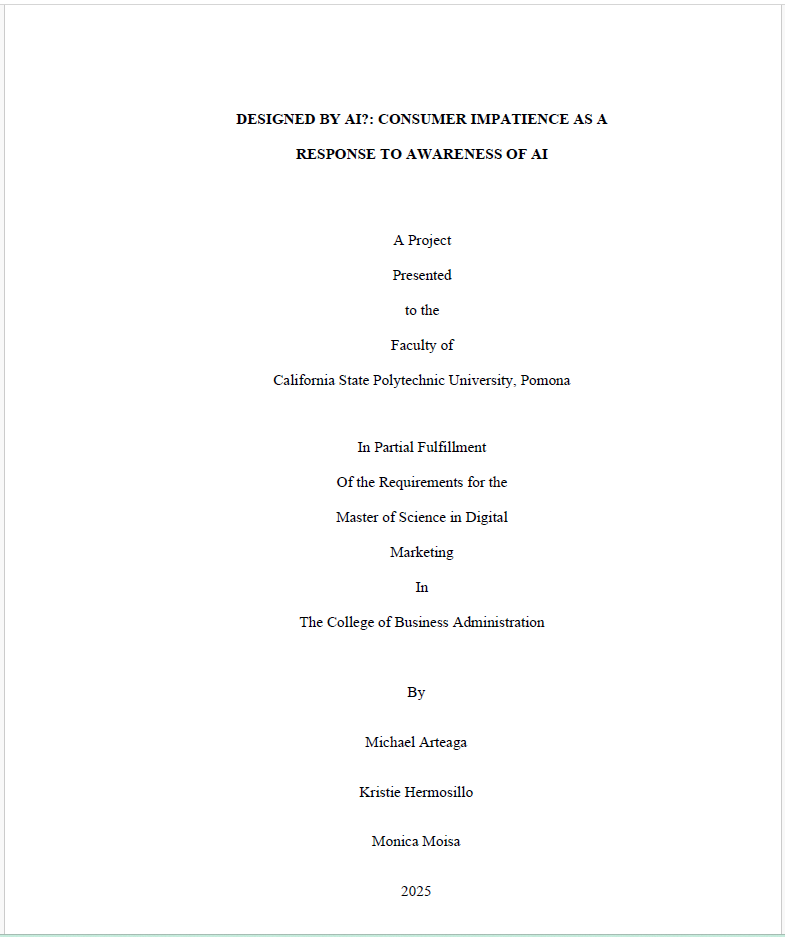
This page should be one page long and include Project Title, appropriate description, the names of all team members, faculty advisor(s), and affiliation.
Follow the format of the template.
Below is how it should look like:
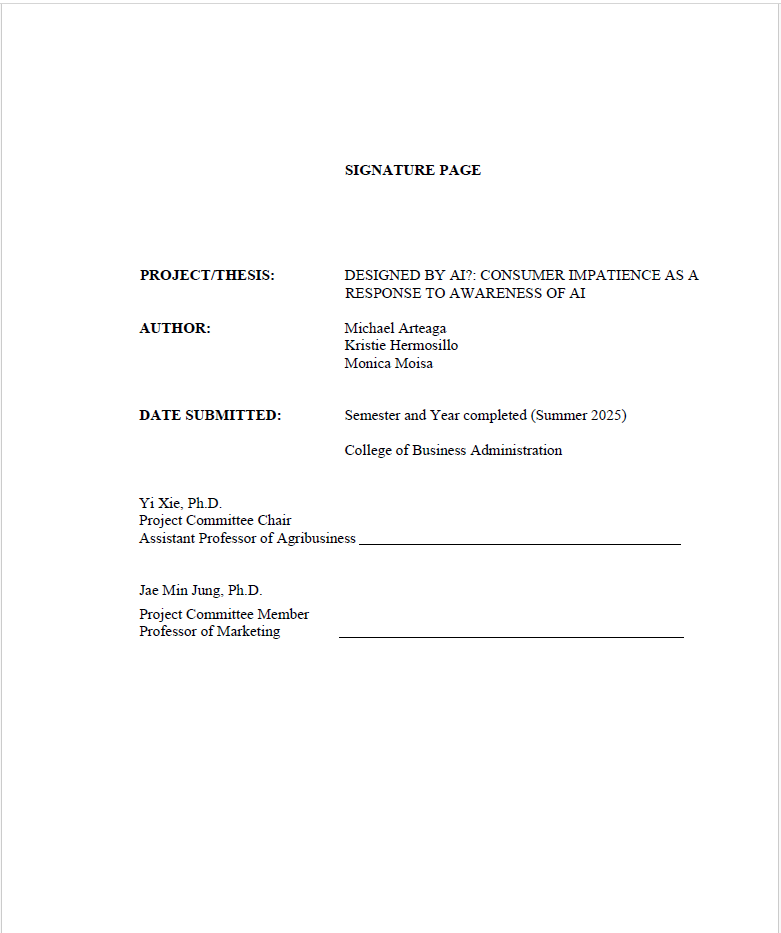
SIGNATURE PAGE
(This page should include Project Title, the names of all team members, and faculty advisor(s)). Download the template and just replace it with your own information. Below is how it should look like.
ACKNOWLEDGMENTS PAGE
(Optional)
This is where students may acknowledge important people in their life that impacted their graduate studies, such as family members, mentors, and friends. Below is a space holder.
Lorem ipsum dolor sit amet, consectetur adipiscing elit. Duis sagittis posuere ligula sit amet lacinia. Duis dignissim pellentesque magna, rhoncus congue sapien finibus mollis. Ut eu sem laoreet, vehicula ipsum in, convallis erat. Vestibulum magna sem, blandit pulvinar augue sit amet, auctor malesuada sapien. Nullam faucibus leo eget eros hendrerit, non laoreet ipsum lacinia. Curabitur cursus diam elit, non tempus ante volutpat a. Quisque hendrerit blandit purus non fringilla. Integer sit amet elit viverra ante dapibus semper. Vestibulum viverra rutrum enim, at luctus enim posuere eu. Orci varius natoque penatibus et magnis dis parturient montes, nascetur ridiculus mus.
ABSTRACT
(The abstract should be no more than 250 words including section headings and keywords.)
Do not write this section until the end of the CEP journey in the summer semester when you have a clear understanding of your contributions to the project. You can refer to the sample summary of individual contribution in the template document for guidance on how to write your own summary.
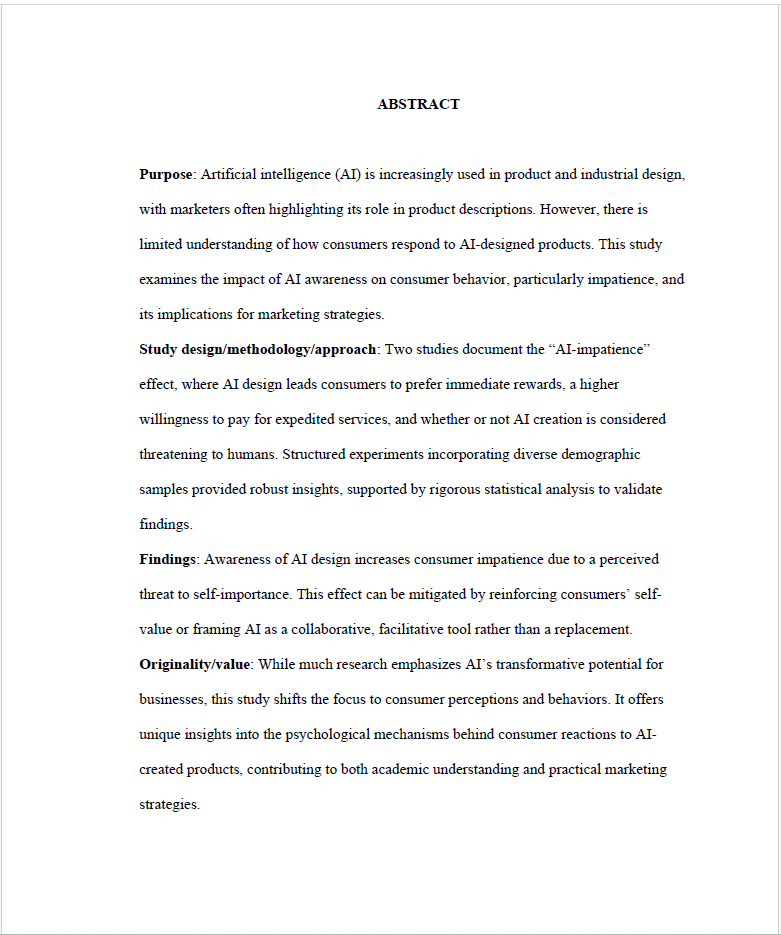
The abstract should be structured with the appropriate sub-headings.
These four sub-headings and their accompanying explanations must always be included:
- Purpose
- Design/methodology/approach
- Findings
- Originality/Value
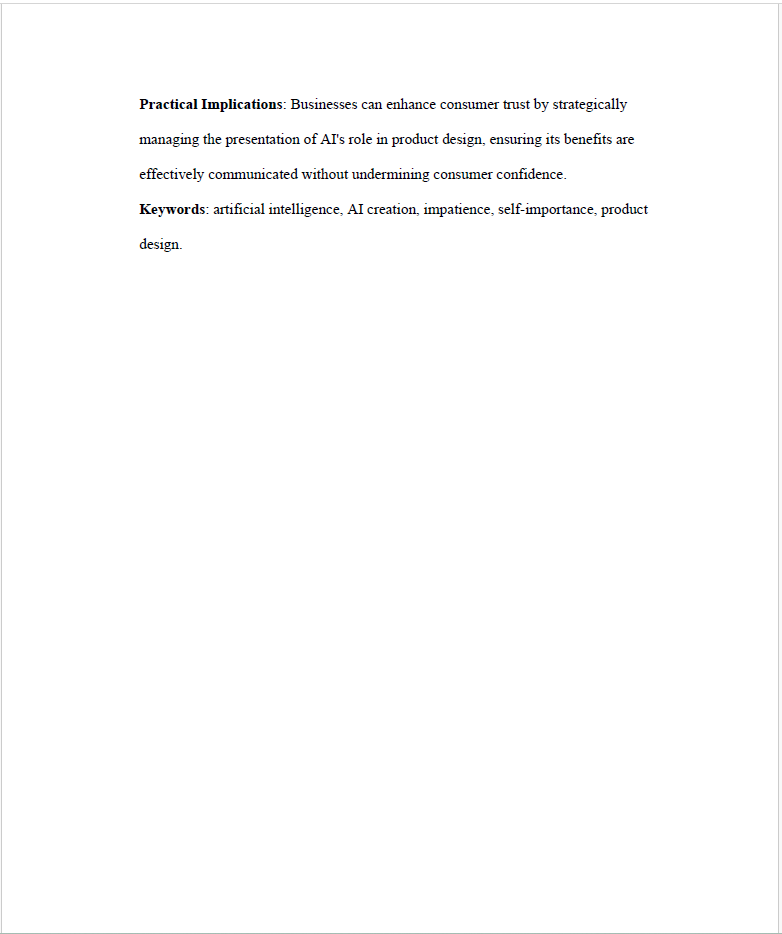
- Practical implications
The below sub-headings are optional and can be included, if applicable:
- Research limitations/implications
- Social implications
The maximum length of your abstract should be 250 words in total, including keywords.
Article keywords:
Your submission should include up to 6 appropriate and short keywords that capture the key topics of the paper. Choosing the right key words can help enhance the online discoverability of your research and may also be used to help find relevant reviewers.Below is a sample of an abstract screenshot from a published CEP on BroncoWorks library repository.
SUMMARY OF INDIVIDUAL CONTRIBUTION
(Each individual contribution statement should be between 75 words and 100 words.)
Do not write this section until the end of the CEP journey in the summer semester when you have a clear understanding of your contributions to the project. You can refer to the sample summary of individual contribution in the template document for guidance on how to write your own summary.
A separate summary should be written under each student’s name describing the unique role the student played for the duration of the project. Each summary should be one paragraph with a minimum of 75 words and a maximum of 100 words.
Below are student names and limpsum paragraph as a placeholder. Replace the student name with your own and the limpsum paragraph below with your own summary of individual contribution. Make sure to write a unique summary for each student, and do not copy and paste the same summary for all students. Each summary should reflect the specific contributions of the individual student to the project.
Note that this section will be published in the CPP library along with the title page and abstract, so make sure to write it in a professional tone and to highlight your unique contributions to the project.
Name of Student 1
Lorem ipsum dolor sit amet, consectetur adipiscing elit. Duis sagittis posuere ligula sit amet lacinia. Duis dignissim pellentesque magna, rhoncus congue sapien finibus mollis. Ut eu sem laoreet, vehicula ipsum in, convallis erat. Vestibulum magna sem, blandit pulvinar augue sit amet, auctor malesuada sapien. Nullam faucibus leo eget eros hendrerit, non laoreet ipsum lacinia. Curabitur cursus diam elit, non tempus ante volutpat a. Quisque hendrerit blandit purus non fringilla. Integer sit amet elit viverra ante dapibus semper. Vestibulum viverra rutrum enim, at luctus enim posuere eu. Orci varius natoque penatibus et magnis dis parturient montes, nascetur ridiculus mus.
Name of Student 2
Lorem ipsum dolor sit amet, consectetur adipiscing elit. Duis sagittis posuere ligula sit amet lacinia. Duis dignissim pellentesque magna, rhoncus congue sapien finibus mollis. Ut eu sem laoreet, vehicula ipsum in, convallis erat. Vestibulum magna sem, blandit pulvinar augue sit amet, auctor malesuada sapien. Nullam faucibus leo eget eros hendrerit, non laoreet ipsum lacinia. Curabitur cursus diam elit, non tempus ante volutpat a. Quisque hendrerit blandit purus non fringilla. Integer sit amet elit viverra ante dapibus semper. Vestibulum viverra rutrum enim, at luctus enim posuere eu. Orci varius natoque penatibus et magnis dis parturient montes, nascetur ridiculus mus.
Name of Student 3
Lorem ipsum dolor sit amet, consectetur adipiscing elit. Duis sagittis posuere ligula sit amet lacinia. Duis dignissim pellentesque magna, rhoncus congue sapien finibus mollis. Ut eu sem laoreet, vehicula ipsum in, convallis erat. Vestibulum magna sem, blandit pulvinar augue sit amet, auctor malesuada sapien. Nullam faucibus leo eget eros hendrerit, non laoreet ipsum lacinia. Curabitur cursus diam elit, non tempus ante volutpat a. Quisque hendrerit blandit purus non fringilla. Integer sit amet elit viverra ante dapibus semper. Vestibulum viverra rutrum enim, at luctus enim posuere eu. Orci varius natoque penatibus et magnis dis parturient montes, nascetur ridiculus mus.
Name of Student 4
Lorem ipsum dolor sit amet, consectetur adipiscing elit. Duis sagittis posuere ligula sit amet lacinia. Duis dignissim pellentesque magna, rhoncus congue sapien finibus mollis. Ut eu sem laoreet, vehicula ipsum in, convallis erat. Vestibulum magna sem, blandit pulvinar augue sit amet, auctor malesuada sapien. Nullam faucibus leo eget eros hendrerit, non laoreet ipsum lacinia. Curabitur cursus diam elit, non tempus ante volutpat a. Quisque hendrerit blandit purus non fringilla. Integer sit amet elit viverra ante dapibus semper. Vestibulum viverra rutrum enim, at luctus enim posuere eu. Orci varius natoque penatibus et magnis dis parturient montes, nascetur ridiculus mus.
Name of Student 5
Lorem ipsum dolor sit amet, consectetur adipiscing elit. Duis sagittis posuere ligula sit amet lacinia. Duis dignissim pellentesque magna, rhoncus congue sapien finibus mollis. Ut eu sem laoreet, vehicula ipsum in, convallis erat. Vestibulum magna sem, blandit pulvinar augue sit amet, auctor malesuada sapien. Nullam faucibus leo eget eros hendrerit, non laoreet ipsum lacinia. Curabitur cursus diam elit, non tempus ante volutpat a. Quisque hendrerit blandit purus non fringilla. Integer sit amet elit viverra ante dapibus semper. Vestibulum viverra rutrum enim, at luctus enim posuere eu. Orci varius natoque penatibus et magnis dis parturient montes, nascetur ridiculus mus.
TABLE OF CONTENTS
This section is a placeholder for the table of contents for those who use Word. If you are using Quarto, you are not required to insert a table of contents here because the table of contents will be generated automatically in the right sidebar for navigation when you submit your report in HTML format.
If you are using Quarto, you may submit HTML file rendered from Quarto, as you can generate toc on the side bar. In fact, there is no way to insert toc in the middle of sections natively in Quarto.
Allow up to three heading levels (h1, h2, and h3) expandable on the sidebar.
This document is already using the method, you can check the source code by clicking the code tools button on the top of the web page.
If you use Word, you will need to insert an automatic table of contents here using the appropriate features in Word (References > Table of Contents). The table of contents should be generated based on the headings used in the document, so make sure to use the correct heading styles for your section titles.
1 CHAPTER 1: INTRODUCTION
(no more than 3 pages in double space)
1.1 Background and Business Problem(s)
1.2 Project Objectives (PO’s)
Sometimes you will be presented with project objectives (PO), instead of analytics objectives (AO), in which case, you must translate the project objectives (marketing or business objectives) into analytics objectives.
PO’s are the business objectives that the client wants to achieve, while AO’s are the analytics objectives that you will use to analyze data and provide insights to help achieve the PO’s.
PO’s will drive Concrete Digital Marketing Plan and Implementation in Ch5
AO’s will drive your activities and analysis throughout the project on Ch1, literature review part of Ch2, Ch3, Ch4, and Recommendation section of Ch5.
If you do not have PO’s, you will need to create them based on the business problem(s) and research questions or hypotheses or AO’s that will drive the research project.
AO’s are derived from the PO’s and should be specific, measurable, and aligned with the research questions or hypotheses that will drive the research project.
For more information on how to tell difference between AO’s and PO’s and how to convert PO’s to AO’s, follow the links.
- PO1: [Insert Project Objective 1 here]
- PO2: [Insert Project Objective 2 here]
- PO3: [Insert Project Objective 3 here]
- PO4: [Insert Project Objective 4 here]
1.3 Analytics Objectives
Each team member must have at least one AO so that they can go through the entire culminating experience process along the AO.
AO’s will drive your activities and analysis throughout the project on Ch1, literature review part of Ch2, Ch3, Ch4, and Recommendation section of Ch5.
However, PO’s will drive Concrete Digital Marketing Plan and Implementation in Ch5.
Each AO should be aligned with the corresponding PO to ensure that the team is working towards solving the business problem(s) effectively.
That way, each member will have rich experience of culminating experience as if they work on a project alone although they work as a team.
Each member should lead at least one analytics objective (AO) that would address corresponding project objective (PO) to help achieve the PO.
There can be more than one AO for a PO, but each AO should be unique and not overlap with other team members’ AOs.
In this section, state (1) how you will address the AO and (2) how the AO will help achieve the corresponding PO introduced earlier.
In doing so, talk about which variables (e.g., constructs, metrics) you will need to use for the AO and what insights you would expect to find.
State the source of data (e.g., GA4, secondary data, survey data, etc.) you will use to address the AO and how you will collect it.
Please note that the analytics objectives should be relevant to the data you can collect and analyze to inform the direction of digital marketing activities. In other words, AO’s must be directly tied to data.
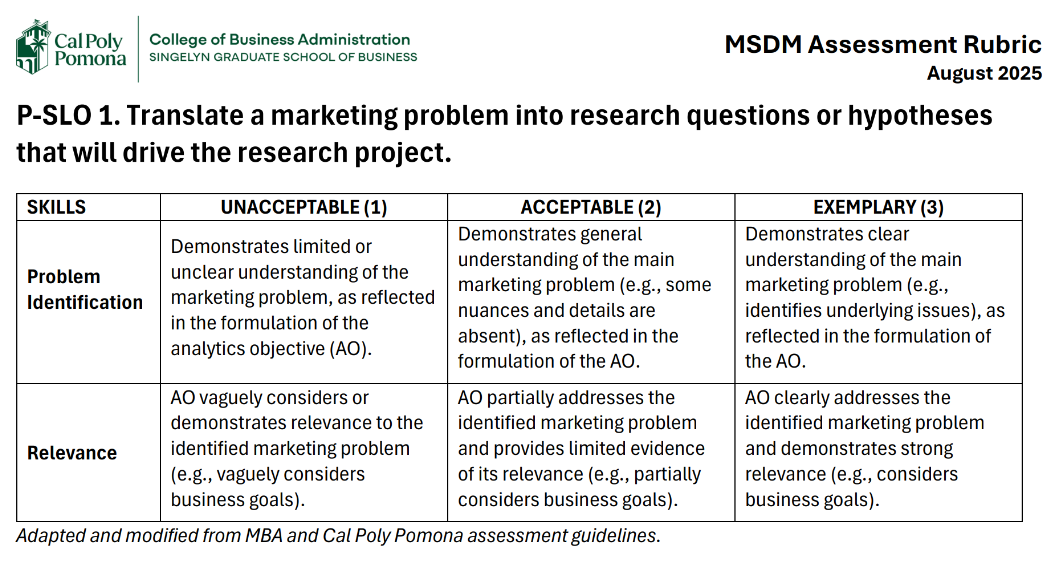
This section will be used to evaluate your performance on SLO 1, which is to translate a marketing problem into research questions or hypotheses that will drive the research project.
The following rubric will be used to evaluate the quality of your model. Make sure to review this rubric carefully and use it as a guide when writing your recommendations section.
1.3.1 AO1. Title of AO1 (Name of Student 1)
PO1: [Insert Project Objective 1 here]
AO1: [Insert Analytics Objective 1 here]
- Data Source: [Insert data source here]
How to address AO1
How AO1 will help achieve PO1
Here is a sample of in-text citation.
Gu et al. (2024) examines how characteristics of AI-generated advertisements influence consumer acceptance through perceived eeriness and perceived intelligence and show that different ad features shape these perceptions in opposite ways, offering practical guidance for advertisers using generative AI. As consumers are ultimate judges for effectiveness of AI-generated contents (Gu et al. 2024), past research that examined consumer reactions to technology will be relevant (e.g., Reich, Kaju, and Maglio 2022; Wu and Jing Wen 2021)
The CSL file and citation syntax do different jobs.
The CSL file controls the formatting appearance — punctuation, italics, author-year order, bibliography layout, etc.
The citation syntax (
-@and[e.g., @key]) controls the content and structure of what gets passed to the CSL formatter.
So the two work together, not in place of each other:
| Syntax | Purpose | Can CSL replace it? |
|---|---|---|
-@gu2024 |
Suppress author name in narrative citation | No |
[@gu2024] |
Standard parenthetical citation | No |
[e.g., @reich2022; @wu2021] |
Parenthetical with prefix | No |
1.3.2 AO2. Title of AO2 (Name of Student 2)
PO2: [Insert Project Objective 2 here]
AO2: [Insert Analytics Objective 2 here]
- Data Source: [Insert data source here]
How to address AO2
How AO2 will help achieve PO2
1.3.3 AO3. Title of AO3 (Name of Student 3)
PO3: [Insert Project Objective 3 here]
AO3: [Insert Analytics Objective 3 here]
- Data Source: [Insert data source here]
How to address AO3
How AO3 will help achieve PO3
1.3.4 AO4. Title of AO4 (Name of Student 4)
PO4: [Insert Project Objective 4 here]
AO4: [Insert Analytics Objective 4 here]
- Data Source: [Insert data source here]
How to address AO4
How AO4 will help achieve PO4
1.3.5 AO5. Title of AO5 (Name of Student 5)
PO5: [Insert Project Objective 5 here]
AO5: [Insert Analytics Objective 5 here]
- Data Source: [Insert data source here]
How to address AO5
How AO5 will help achieve PO5
1.4 Significance of the Topic
2 CHAPTER 2: BACKGROUND AND ANALYTICS OBJECTIVES
(no specific page length guideline)
If you are conducting a Client Consulting Project type, you have a company-specific analysis. Thus, follow the structure for Chapter 2 presented below.
For the Client Consulting Project type, Chapter 2 should include a comprehensive analysis of the client company and its industry, as well as an investigation of existing research frameworks/models that support the analytics objectives. The purpose of this chapter is to provide a thorough understanding of the client’s business context and to establish a strong foundation for the analytics objectives by grounding them in relevant theories and models.
On the other hand, if you do not have a specific client company to analyze, you are completing a Basic/Applied Academic Research Project type where you are likely to benefit general public or the whole industry. In this case, Chapter 2 should follow the structure of the front end of an academic research paper. For details, refer to the 2. Guidelines for Basic/Applied Academic Research Project.
2.1 Client (Company) Background
2.1.1 Company Mission/Vision
2.1.2 Core Competencies
2.1.3 Value Propositions
2.1.4 Business Objectives
2.2 Description of the Client’s Current Marketing Program
2.2.1 Marketing Team and Expertise
2.2.2 Current Target Market
2.2.3 Current Positioning and Perceptual Map
Current Perceptual Map
2.2.4 Current Product/Services
2.2.5 Current Pricing
2.2.6 Current Marketing Channels
2.2.7 Current Integrated Marketing Communications
2.3 Description of the Company’s Current Digital Marketing Practices
2.3.1 Brand Persona
2.3.2 Digital Marketing Channels/Medium
Website and Landing Page
Keyword Research and SEO
Email Marketing
Paid Search Advertising
Display advertising
2.3.3 Other digital marketing channels & tactics
Conversion Rate Optimization (CRO)
Mobile Application
Affiliate Marketing
Influencer Campaigns
2.3.4 Allocation of Resources to Customer-Influence Efforts
Demand Generation
Demand Harvesting
Loyalty Building
2.3.5 Analytics Infrastructure
2.4 Competitive Analysis
2.4.1 Industry Size
Number of Companies
Number of Employees
Annual Revenue and Key Financial Information
Existence of Dominant Players and Competitors
2.4.2 Industry Outlook
Industry Life Cycle
Future Sales/Profit Growth Outlook
2.4.3 Key Competitors and Their Digital Marketing Strategies
Target Market
Positioning
Website and Landing Page
Keyword research and SEO
Email Marketing Strategy
Paid Search Advertising
Display Advertising
Conversion Rate Optimization (CRO)
Mobile Application
Affiliate Marketing
Influencer Campaigns
Summary Table of Comparison
2.5 Customer Analysis
2.5.1 Segments and Their Brief Justification
Develop a profile of customers for each segment in terms of demographics, psychographics, benefits sought, behavioral patterns, etc.
Segment Name A
Segment Name B
Segment Name C
Segment Name D
Summary Table of Segments
In the table, each column should represent a segment, and each row should represent a customer characteristic (e.g., demographics, psychographics, benefits sought, behavioral patterns). The cell descriptions should indicate the profile of customers in each segment for each characteristic.
2.5.2 Segment Analysis
Evaluate the potential for each segment on such criteria as identifiability, actionability, substantiality, and accessibility.
Summary Table of Segment Evaluation
Based on the segment evaluation, identify the most attractive segment(s) to target and justify your choice.
In the table, each column should represent a segment, and each row should represent an evaluation criterion, plus overall attractiveness. The cell values should indicate how well each segment meets each criterion, using a consistent rating system (e.g., high, medium, low or a numerical scale).
2.6 SWOT Analysis
2.6.1 Strengths
2.6.2 Weaknesses
2.6.3 Opportunities
2.6.4 Threats
2.6.5 Summary: SWOT quadrants
2.7 Investigation of Currently Available Research Framework/Model
The main purpose of this section is to gain understanding of the existing research on the topic of your project and assess if you can avoid doing redundant research that can address your analytics objectives. If indeed, there is sufficient existing research that can answer your analytics objectives, why can’t you just use the knowledge? Thus, this section is crucial for establishing a solid foundation for your research. To this end, you will be answering the four sections below by filling out the four sections. Make sure you understand what is required for each section.
Existence of Well-established Models (2-3 pages per AO)
Identify well-established consumer behavior theory/models/frameworks or analytical approaches relevant to the AO.
Describe how the theory/models support the AO conceptual development in the context of solving the problem.
Adequateness of Gathered Information (a paragraph per AO)
Assess whether the gathered information (above) is sufficient in addressing the AO and thus solving the business problem. Consider aspects such as application, accuracy, consistency, potential bias, and whether the information aligns with your research needs.
If the gathered information is sufficient, explain how you will use the information to accomplish the AO and solve the business problem. If not, explain why the information is not sufficient and what you will do to fill the gap (e.g., additional analysis, primary research, etc.).
Need for Additional Analysis (a paragraph per AO)
Identify if there is a need for additional analysis to address the AO in the context of the business problem. Consider if there is a need for alternative modeling techniques, methods, or data sources (e.g., primary research) to fill gaps or enhance accuracy, and how they would improve the AO.
If you had concluded in Step 2 that the gathered information is sufficient, you may not need to do additional analysis. In that case, explain why the information is sufficient and how you will use it to accomplish the AO and solve the business problem.
If you had concluded in Step 2 that the gathered information is not sufficient, you will likely need to do additional analysis. In that case, explain what additional analysis you will do and how it will help accomplish the AO and solve the business problem.
In this case, articulate specific research questions or hypotheses that will guide your additional analysis. You may also need to identify the data sources, analytical techniques, and models you will use to address the AO.
The research questions or hypotheses should be specific, measurable, and aligned with the AO. They should also be feasible to answer given the available data and resources. This means that you may need at least one research question or hypothesis for each AO, and they should be clearly stated in a way that allows for empirical testing or analysis. Some examples of research questions or hypotheses are:
- Research Question: “How does the frequency of social media engagement affect brand loyalty among millennials?”
- Hypothesis: “Higher levels of social media engagement are positively associated with increased brand loyalty among millennials.”
If your data source is primary data, you will be asked to use research questions or hypotheses to guide your questionnaire development for survey data collection in Chapter 3.
If your data source is secondary data, the research questions or hypotheses will still be useful in guiding your plan for data collection and analytics method section of Chapter 3 and analysis/modeling section of Chapter 4.
Assessment and Affirmation of Analytics Objectives (no more than 1 page per AO)
- In this section, you will evaluate your original AO specified in Chapter 1 in light of the information you have gathered and analyzed in the previous sections. You will specify how the AO aims to address the identified business problem(s). You will identify the analytical techniques, models or tools you plan to use. You will explain how these techniques will help accomplish the AO and why they are appropriate.
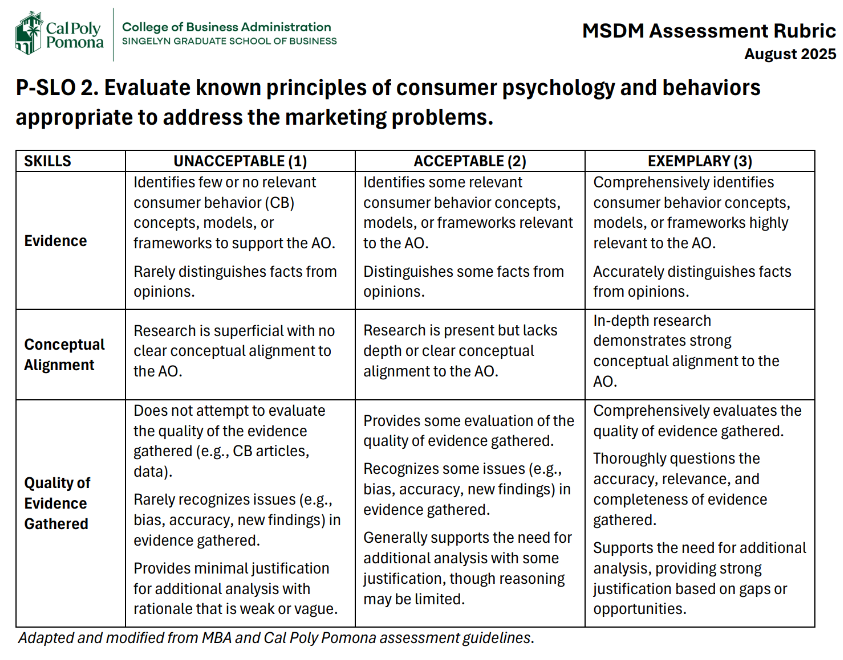
This section will be used to evaluate your performance on SLO 2, which is to evaluate known principles of consumer psychology and behaviors appropriate to address the marketing problems.
The following rubric will be used to evaluate the quality of your model. Make sure to review this rubric carefully and use it as a guide when writing your recommendations section.
CHAPTER 2: For Basic/Applied Academic Research Project
(3 - 4 pages per AO). Use the same chapter title as the client consulting project.
If you are completing a Basic/Applied Academic Research Project type, you do not have a client company to analyze for company-specific analysis. Therefore, you cannot fill out the client-specific sections. This is why you should follow the structure of the front end of an academic research paper.
For the Basic/Applied Academic Research Project type, Chapter 2 should follow the structure of the front end of an academic research paper, which includes an overall introduction, a literature review, theoretical development, and hypothesis development for each AO. The purpose of this chapter is to provide a comprehensive understanding of the research topic and to establish a strong foundation for the analytics objectives by grounding them in relevant theories and models.
You will find the content and structure guidelines below is consistent with the academic papers published in many journals, such as the Journal of Marketing, Journal of Consumer Research, Journal of the Academy of Marketing Science, etc. You can refer to these journals for examples of how to structure and write this chapter.
2.8 Overall Introduction
Briefly introduce the business or social problem(s) the group is addressing. Summarize the purpose of the study, key theoretical concepts (constructs), analytical focus, and the expected practical and academic contributions.
You can write this section in a way that is similar to the introduction section of an academic research paper. Refer to journal articles for examples of how to write this section.
This section is for the entire AO’s, so you should not write this section separately for each AO. Instead, you can write this section once at the beginning of Chapter 2, and then write the literature review, theoretical development, and hypothesis sections separately for each AO.
3 CHAPTER 3: METHODS
(6 - 10 pages)
This chapter should provide a detailed description of the methods used to accomplish the analytics objectives. The methods should be described in sufficient detail to allow for replication by other researchers. The methods should be appropriate for the analytics objectives and should be justified based on the literature review and theoretical development presented in Chapter 2.
For projects that need primary data collection, a survey instrument should be prepared and submitted as part of Chapter 3.
For projects that use secondary data, the data source should be described in detail, including how the data was obtained and any limitations of the data.
For projects that uses both primary and secondary data, both data collection methods should be described in detail.
For more information about data collection methods, data sources, and instruments, refer to the Data Collection for the Above AO section of the main capstone project page.
3.1 Survey Data
3.1.1 Population
3.1.2 Sampling Frame
3.1.3 Sampling Method
3.1.4 Data Collection
3.1.5 Sample Characteristics
Age
Gender
Race/ethnicity
Education
Income
Occupation
Relevant Behavioral Variables
Product Usage Variables.
3.1.6 Measures
Define the constructs in your analysis and describe how each construct will be operationalized (one item vs. multi-item). Explain what type of scale will be used (nominal, ordinal, interval, ratio), source, etc. Provide this information for each construct categorized under the following headings (IV, DV, Control). Each construct name will be another subheading. See journal articles for an idea.
Independent Variables. (if applicable)
Variable Name 1
Variable Name 2
Variable Name 3
Variable Name 4
Dependent Variables (if applicable)
Variable Name 5
Variable Name 6
Variable Name 7
Variable Name 8
Control Variables (if applicable)
Variable Name 9
Variable Name 10
Variable Name 11
Variable Name 12
3.1.7 Analytics Methods to Employ
(1-2 pages per AO)
In this section, provide specific data science methods, variables/features to be used, and justifications for the methods and choice of the variables/features.
Provide a sufficient amount of writing (one or two paragraphs) under each AO. The word sufficiency is relativistic, depending on the objective.
Your description should be able to inform readers of what the method is, why you want to use it, and what variables/features you plan to use, such that readers do not have questions.
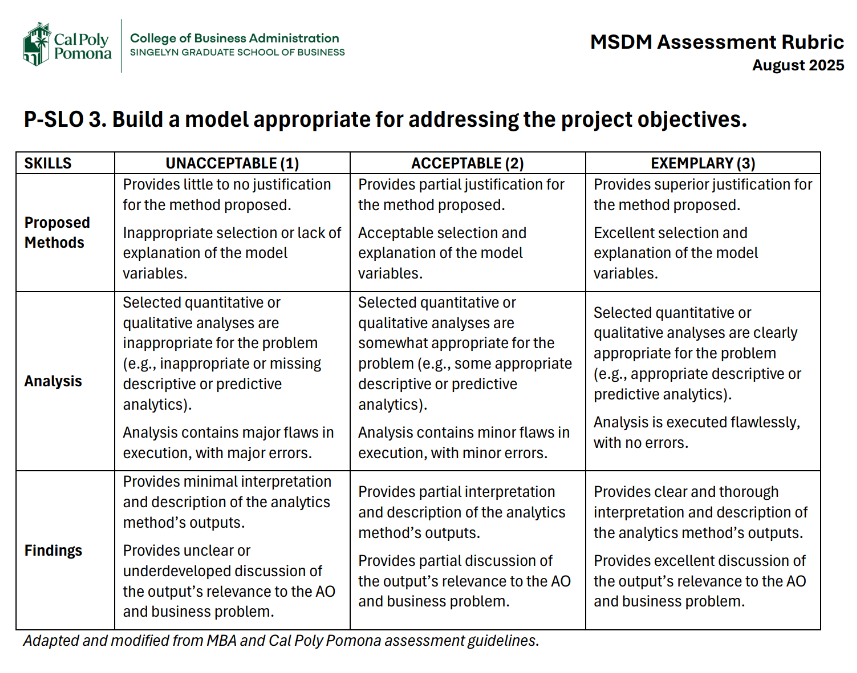
This section will in part be used to evaluate your performance on SLO 3, which is to build a model appropriate for addressing the project objectives. The specific model you build will depend on the analytics objectives you have set for your project and the data you have collected. Make sure to choose a model that is appropriate for your analytics objectives and to justify your choice of the model based on the literature review and theoretical development presented in Chapter 2.
The following rubric will be used to evaluate the quality of your model. Make sure to review this rubric carefully and use it as a guide when writing your recommendations section.
3.2 Secondary Data
3.2.1 Data Source
3.2.2 Population
3.2.3 Sampling Frame
3.2.4 Sampling Method
3.2.5 Data Wrangling
Import
Tidying
Joining the Data
3.2.6 Understanding the Data
Transform
Visualize
3.2.7 Programming
3.2.8 Sample Characteristics
Relevant Demographic Variables
Relevant Behavioral Variables
Product Usage Variables
3.2.9 Measures
Define the constructs in your analysis and describe how each construct will be operationalized (one item vs. multi-item). Explain what type of scale will be used (nominal, ordinal, interval, ratio), source, etc. Provide this information for each construct categorized under the following headings (IV, DV, Control). Each construct name will be another subheading. See journal articles for an idea.
Independent Variables. (if applicable)
Variable Name 1
Variable Name 2
Variable Name 3
Variable Name 4
Dependent Variables (if applicable)
Variable Name 5
Variable Name 6
Variable Name 7
Variable Name 8
Control Variables (if applicable)
Variable Name 9
Variable Name 10
Variable Name 11
Variable Name 12
3.2.10 Analytics Methods to Employ
(1-2 pages per AO)
In this section, provide specific data science methods, variables/features to be used, and justifications for the methods and choice of the variables/features.
Provide a sufficient amount of writing (one or two paragraphs) under each AO. The word sufficiency is relativistic, depending on the objective.
Your description should be able to inform readers of what the method is, why you want to use it, and what variables/features you plan to use, such that readers do not have questions.
This section will in part be used to evaluate your performance on SLO 3, which is to build a model appropriate for addressing the project objectives. The specific model you build will depend on the analytics objectives you have set for your project and the data you have collected. Make sure to choose a model that is appropriate for your analytics objectives and to justify your choice of the model based on the literature review and theoretical development presented in Chapter 2.
The following rubric will be used to evaluate the quality of your model. Make sure to review this rubric carefully and use it as a guide when writing your recommendations section.
4 CHAPTER 4: ANALYSIS/MODELING AND RESULTS
(5-10 pages per AO)
In this section, you will present data analysis andthe results of your analysis/modeling for each AO. The structure of this section may vary based on your project objectives and the nature of your analysis/modeling, but the following are common components to include for each AO.
- For each AO, you should have a separate subsection that includes an introduction, a description of the descriptive analytics and results, a description of the predictive analytics and results, and a summary of findings.
If your project analytics objectives do not involve quantitative methods, make appropriate alterations in consultation with your professors.
This section will in part be used to evaluate your performance on SLO 3, which is to build a model appropriate for addressing the project objectives. The specific model you build will depend on the analytics objectives you have set for your project and the data you have collected. Make sure to choose a model that is appropriate for your analytics objectives and to justify your choice of the model based on the literature review and theoretical development presented in Chapter 2.
The following rubric will be used to evaluate the quality of your model. Make sure to review this rubric carefully and use it as a guide when writing your recommendations section.
5 CHAPTER 5: DATA-INFORMED MARKETING STRATEGY AND CONCLUSION
(13 - 15 pages)
This chapter should provide your client with a comprehensive discussion of the data-informed marketing strategy that you recommend based on the findings from your analysis. The specific structure of this chapter may vary based on your project goals and the nature of your recommendations, but the following are common components to include.
If your project is basic/applied academic research, you may tweak the structure of this chapter to fit your project. For example, you may have a section on “Implications for Practice” where you can provide recommendations for practitioners based on your research findings, and a separate section on “Implications for Research” where you can discuss how your findings contribute to the academic literature and suggest directions for future research. Refer to journal articles to see how to structure this chapter for basic/applied academic research projects. For more details, see 2. Guidelines for Basic/Applied Academic Research section.
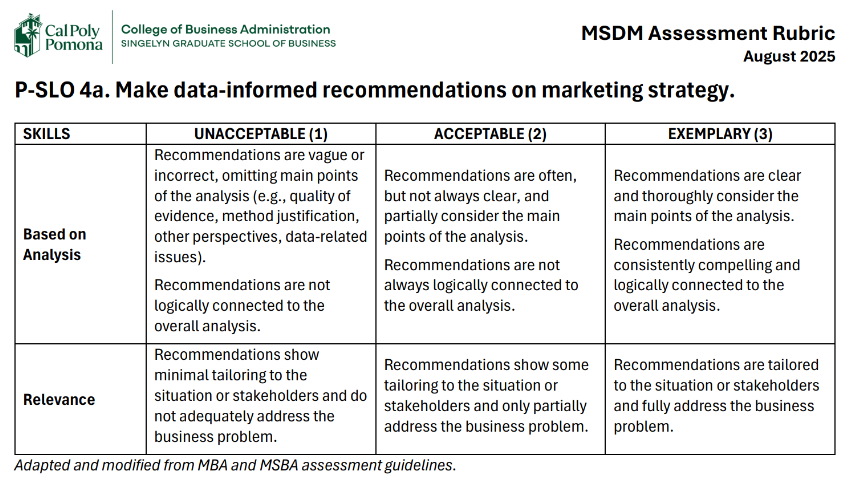
The following rubric will be used to evaluate the quality of your recommendations and the justification for those recommendations. Make sure to review this rubric carefully and use it as a guide when writing your recommendations section.
5.1 Summary and Recommendations for Each AO
5.2 Concrete Digital Marketing Plan
Instructions for the Digital Marketing Plan
Why This Guideline Is Provided?
In conversations with students, I observed significant variation in how students interpreted the specificity of the digital marketing plan.
Some students were unsure about who should create the plan and how specific it should be. Some expected their clients to provide the content and ideas.
Therefore, the goal of this guideline is to give students clear guidance on the breadth and depth of the content expected in the digital marketing plan.
The Breadth of the Digital Marketing Plan
The plan should include a clear target market, positioning strategy, campaign objectives, digital marketing tactics, content examples, mock campaign materials, KPIs, tracking methods, and a post-implementation evaluation plan.
Below is an overview of possible components of a digital marketing plan. Not all digital marketing channels will be relevant to your project. Choose the channels and tactics that are necessary to achieve your project objectives.
Target market
Positioning and perceptual map
Brand persona
Campaign objectives
- SMART objectives
- KPI alignment
SEO strategy
- Keyword research
- Keyword mapping
- SEO content recommendations
Website and landing page plan
- Website objectives
- KPIs
- Website structure
- Page recommendations
- Mock website or landing page
Social media strategy
- Platform selection
- KPIs
- UTM tracking
- Profile recommendations
- Engagement strategy
- Content creation
- Content curation
- Mock posts
Email marketing strategy
- Email objectives
- KPIs
- UTM tracking
- Email content plan
- Mock email
- A/B testing
Paid advertising strategy
- Search advertising
- Display advertising
- Social media advertising
- Budget allocation
Other digital marketing channels and tactics
- Conversion rate optimization
- Mobile application
- Affiliate marketing
- Influencer campaigns
Implementation timeline
How Should You Determine the Breadth of the Content?
You cannot include every digital marketing component listed above because of factors such as time, budget, the client’s interests, and the project objectives.
Project objectives are the most important consideration. Project objectives were developed early in the proposal stage of the project, shared with students, and agreed upon by all stakeholders, including the client, faculty, and students. The proposal, data collection, analysis, and recommendations should all be geared toward achieving the project objectives. Therefore, it makes the most sense to choose the most effective digital marketing channels, tactics, and methods rather than selecting them haphazardly.
- The easiest and most effective way to determine the digital marketing plan is to translate your recommendations into a concrete campaign plan, assuming that your recommendations are based on insights from the data and/or literature. In other words, you should use insights from your analysis to create an actionable plan. Digital marketing components that cannot be justified should be avoided.
Client requests can also influence your decisions. Clients may feel that a change in the plan is necessary because of a new direction or shifting priorities in their business environment. Many things may have changed since the original project objectives were identified almost one year ago. In this situation, the group should weigh various factors, such as feasibility, the group’s interest in the new direction, value to the client, and educational value to the group. There is no single correct answer. All stakeholders, including students, clients, and the faculty lead, should have a thoughtful conversation to reach a consensus.
Depth of Your Digital Marketing Plan
Once you have decided on the scope of work, you will need to go deeper in your plan. How detailed should it be?
It should be detailed enough to help your audience picture what the execution would look like.
For example, if you propose a social media campaign with a series of social media posts, you should suggest the type of post, such as a carousel, story, reel, or graphic. You should also create the text and visuals that go along with it. See the sample below.
If you propose a website redesign with SEO, simply describing it verbally would not be effective. You could create a mock website using a free website-building tool and show the homepage and other key pages. See the sample below.
Your goal is to show not only what the brand should do, but also why it should do it, how it should be executed, and how success should be measured.
Sample Digital Marketing Plan
To give you an idea, here is a sample of work by a group of students who participated in the DMC Program under the guidance of two professors. The client was very pleased with the proposal and adopted the proposed concrete plans:
The Digital Marketing Plan proposal in the sample is quite comprehensive and reflects one semester of work. The students spent one semester understanding the client, analyzing competitors, and developing recommendations. Their research on past social media content revealed that certain types of posts outperformed others in engagement. Therefore, they focused on high-engagement content formats, such as reels and carousels.
Based on this proposal, they spent another semester implementing the plan, which is explained in detail in the next section: Section 5.3.
Note: For your information, the DMC Program is one of the initiatives at the Center for Customer Insights and Digital Marketing. It is intended to give selected undergraduate and graduate students a rich experiential learning opportunity. Many MSDM students in selected courses, such as IBM 6010, IBM 6100, and IBM 6300, have also participated in the past as part of the program under the same overall pedagogy established in the DMC Program.
How Success is Measured?
It is critically important that you must produce a Concrete Digital Marketing Plan — Section 5.2 — and get it approved by your faculty and client before you start the implementation, whiich is described in the next section — Section 5.3 — for a few reasons.
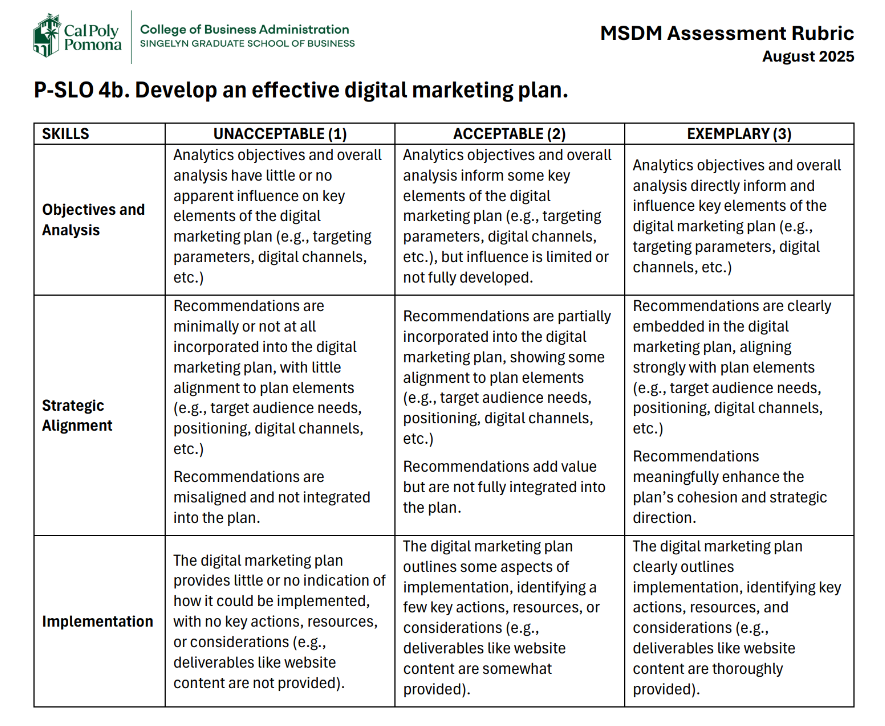
Student Learning Outcome 4b will be evaluated based on the quality of your digital marketing plan, not the implemenation outcome since successful implemenation often depend on various factors, some of which are beyond your control. If you do not produce a concrete plan, it will be difficult for you to achieve a high score on SLO 4b (see below).
A concrete plan will help you stay focused and organized during the implementation phase. It will serve as a roadmap for your implementation efforts and help you track your progress.
A concrete plan will also help you communicate effectively with your client and other stakeholders. It will ensure that everyone is on the same page regarding the goals, strategies, tactics, and expected outcomes of the campaign.
Also remember that the digital marketing plan should be based on insights from your data analysis and/or literature review.
- You should not include digital marketing components that cannot be justified by insights from your analysis or literature. A plan that includes unjustified components may not be effective and may not achieve the desired outcomes. Therefore, it is important to ensure that your plan is grounded in evidence and insights from your research.
The MSDM Program will use the following Assessment Rubric
Assessment Rubric for SLO 4b: Develop an effective digital marketing plan. The following rubric will be used to evaluate the quality of your digital marketing plan. Make sure to review this rubric carefully and use it as a guide when writing your plan.
Below is a comprehensive guide that expands on the structure provided above. Students should choose the digital marketing channels and tactics that are most appropriate for achieving the project objectives.
Note that you are not required to include all the components listed below. The key is to ensure that your plan is comprehensive enough to achieve the project objectives and is based on insights from your data analysis and/or literature review. You should also ensure that your plan is actionable, specific, and measurable.
5.2.1 Target Market
Define the specific audience your campaign will target.
Include relevant characteristics such as:
- Demographics
For example: age, gender, income, education, location - Psychographics
For example: lifestyle, values, motivations, interests - Behavioral characteristics
For example: online search behavior, purchase behavior, media usage - Needs or pain points
- Preferred digital platforms
- Stage in the customer journey
You may also create one or more customer personas to make the target audience more concrete.
Each persona may include:
- Name
- Age
- Occupation or student status
- Lifestyle
- Goals
- Frustrations
- Media habits
- Reason for buying or engaging with the brand
5.2.2 Positioning and Perceptual Map
Explain how the brand should be positioned in the market based on your analysis.
You should include:
- Main competitors
- Key dimensions of comparison
For example: price, quality, sustainability, convenience, authenticity, innovation, luxury, accessibility - A perceptual map showing where the brand currently stands and/or where it should be positioned
- Explanation of the desired brand position
Your discussion should answer:
- What makes the brand different?
- Why should the target market care?
- How should customers perceive the brand after the campaign?
- How does this positioning respond to the data analysis?
5.2.3 Brand Persona
Describe the brand personality that should guide the tone, visuals, and messaging of the campaign.
Include:
- Brand voice
For example: professional, friendly, playful, inspirational, premium, educational - Visual style
For example: minimalist, colorful, natural, bold, youthful - Emotional appeal
- Key message themes
- Example phrases or slogans
- Words the brand should use
- Words the brand should avoid
This section helps ensure that all website, social media, email, and advertising content feels consistent.
5.2.4 Campaign Objectives
Clearly state the main objectives of your digital marketing campaign.
Use SMART objectives whenever possible. Objectives should be:
- Specific
- Measurable
- Achievable
- Relevant
- Time-bound
Examples:
- Increase website traffic by 20% within three months.
- Increase email sign-ups by 15% during the campaign period.
- Improve Instagram engagement rate from 2% to 4%.
- Increase product page visits from paid search ads by 25%.
- Generate 100 qualified leads through landing page form submissions.
You may list your objectives as:
Project Objective #1
Describe the objective and explain why it matters.
Project Objective #2
Describe the objective and explain why it matters.
Project Objective #3
Describe the objective and explain why it matters.
Project Objective #4
Describe the objective and explain why it matters.
For each objective, include the relevant KPI and the data source you would use to evaluate it.
5.2.5 SEO Strategy
SEO Goals
Explain how SEO will support your campaign objectives.
For example, SEO may help the brand:
- Improve visibility on search engines
- Attract high-intent visitors
- Increase organic traffic
- Improve ranking for relevant keywords
- Support product, service, or content discovery
Keyword Research and Ranking
Conduct keyword research based on your target market and campaign goals.
Include:
- Seed keywords
- Search intent
For example: informational, navigational, commercial, transactional - Search volume, if available
- Keyword difficulty, if available
- Relevance to the brand
- Current ranking, if available
- Competitor ranking, if available
You should identify the top five best keywords for each seed keyword and explain why they were selected.
A suggested table format:
| Seed Keyword | Recommended Keyword | Search Intent | Reason for Selection | Target Page |
| sustainable skincare | natural face cream | Commercial | Relevant to target audience and product category | Product page |
Keyword Mapping
Map selected keywords to specific pages of the website.
Include:
- Homepage keywords
- Product or service page keywords
- Blog or educational content keywords
- Landing page keywords
- FAQ page keywords
Explain how the keywords match the purpose of each page.
SEO Content Recommendations
Suggest content that can improve organic search performance.
Examples:
- Blog posts
- FAQ pages
- Product guides
- How-to articles
- Comparison pages
- Educational videos
- Local SEO content, if relevant
Each content idea should include:
- Target keyword
- Target audience
- Search intent
- Brief content description
- Expected KPI
5.2.6 Website and Landing Page Plan
Website Objectives
Explain the role of the website in your digital marketing plan.
For example, the website may be designed to:
- Generate leads
- Increase purchases
- Educate customers
- Build trust
- Encourage newsletter sign-ups
- Drive appointment bookings
- Support brand awareness
Relevant Website KPIs
Select KPIs that match your website objectives.
Possible KPIs include:
- Form submissions
- Conversion rate
- Bounce rate
- Average session duration
- Number of purchases
- Number of sessions
- Number of visitors
- Pages per session
- Add-to-cart rate
- Newsletter sign-ups
- Click-through rate on key buttons
- Landing page conversion rate
Do not simply list KPIs. Explain why each KPI is relevant.
Website Structure and Outline
Provide a clear website structure or hierarchy.
For example:
- Homepage
- About Us
- Products or Services
- Product Detail Pages
- Blog or Resources
- Reviews or Testimonials
- FAQ
- Contact Us
- Landing Page for Campaign
You may include a simple sitemap or visual hierarchy.
Specific Page Recommendations
For each important page, describe:
- Page goal
- Target audience
- Main message
- Key sections
- Call-to-action
- Target keywords
- Relevant KPIs
Example:
Homepage
- Goal: Introduce the brand and direct visitors to key products.
- Main message: Affordable, sustainable products for everyday use.
- CTA: Shop Now / Learn More / Sign Up.
- KPI: Click-through rate to product pages.
Mock Website or Landing Page
Create a mock website, landing page, or wireframe.
Your mockup should show:
- Page layout
- Main headline
- Key visuals
- Navigation menu
- Call-to-action buttons
- Product or service information
- Trust-building elements
For example: reviews, testimonials, certifications, awards - Lead capture or purchase path
You may use tools such as Canva, Figma, Wix, Shopify mockups, PowerPoint, or another design tool.
5.2.8 Email Marketing Strategy
Email Marketing Objectives
Explain the role of email marketing in the campaign.
Possible objectives include:
- Nurture leads
- Promote products
- Increase repeat purchases
- Encourage sign-ups
- Share educational content
- Recover abandoned carts
- Build customer loyalty
Relevant Email KPIs
Choose KPIs that match the email objectives.
Possible KPIs include:
- Open rate
- Click-through rate
- Conversion rate
- Unsubscribe rate
- Bounce rate
- Email sign-ups
- Revenue per email
- Abandoned cart recovery rate
- List growth rate
Explain why each KPI is important.
Use of UTM Tracking and GA4
Explain how email links will be tracked using UTM parameters and GA4.
Example:
utm_source=newsletter&utm_medium=email&utm_campaign=summer_promotion&utm_content=button_cta
Explain how this helps identify which email content drives traffic or conversions.
Email Content Plan
Develop specific email content ideas.
For each email, include:
- Email purpose
- Target segment
- Subject line
- Preview text
- Main message
- Call-to-action
- Timing
- KPI
Example emails:
Email #1: Welcome Email
- Purpose: Introduce the brand and encourage first visit.
- Subject line: Welcome to [Brand Name]
- CTA: Explore Our Products
- KPI: Open rate and click-through rate
Email #2: Product Education Email
- Purpose: Explain product benefits.
- CTA: Learn More
- KPI: Click-through rate
Email #3: Promotional Email
- Purpose: Encourage purchase.
- CTA: Shop Now
- KPI: Conversion rate
Mock Email
Create a mock email design.
The mock email should include:
- Subject line
- Preview text
- Header
- Main image or visual
- Body copy
- Call-to-action button
- Footer
- Brand-consistent design
- UTM-tagged links, if applicable
A/B Testing Plan
Propose at least one A/B test.
Possible A/B tests include:
- Subject line A vs. subject line B
- CTA button wording
- Email layout
- Promotional offer
- Personalization
- Send time
- Image vs. no image
For each test, include:
- Hypothesis
- Version A
- Version B
- KPI used to determine the winner
- How results would inform future campaigns
5.2.9 Paid Advertising Strategy
Paid Advertising Objectives
Explain why paid advertising is needed.
Paid ads may be used to:
- Increase awareness quickly
- Drive traffic to a landing page
- Retarget website visitors
- Promote a specific product
- Generate leads
- Support campaign launch
- Improve conversion volume
Search Advertising
If search ads are relevant, include:
- Campaign objective
- Target keywords
- Match types, if applicable
- Ad groups
- Example ad copy
- Landing page
- Budget recommendation
- Bidding strategy
- Relevant KPIs
Possible KPIs:
- Click-through rate
- Cost per click
- Conversion rate
- Cost per conversion
- Quality score
- Return on ad spend
Example structure:
Search Advertising Campaign
- Campaign goal: Drive high-intent traffic to product page.
- Target keyword: “organic face cream”
- Headline: Natural Skincare for Everyday Glow
- CTA: Shop Now
- Landing page: Product page
- KPI: Conversion rate and cost per conversion
Display Advertising
If display ads are relevant, include:
- Campaign objective
- Target audience
- Placement strategy
- Visual message
- Example banner ad
- Landing page
- Retargeting strategy, if applicable
- Relevant KPIs
Possible KPIs:
- Impressions
- Reach
- Click-through rate
- View-through conversions
- Cost per thousand impressions
- Cost per click
Paid Advertising Budget Allocation
Provide a suggested budget allocation across channels.
For example:
| Channel | Budget % | Reason |
| Search Ads | 40% | Captures high-intent customers |
| Social Media Ads | 40% | Builds awareness and engagement |
| Display Retargeting | 20% | Re-engages previous visitors |
Students should justify the budget based on campaign objectives and target audience behavior.
5.2.10 Other Digital Marketing Channel and Tactics
Conversion Rate Optimization
Conversion Rate Optimization, or CRO, focuses on improving the percentage of users who complete a desired action, such as making a purchase, submitting a form, signing up for an email list, downloading a resource, or booking an appointment.
Students should identify where users may be dropping off and recommend improvements that make conversion easier, clearer, or more persuasive.
What to Include
Discuss how the brand can improve conversion performance through website, landing page, checkout, or lead-generation improvements.
Possible CRO recommendations include:
Improving call-to-action buttons
Simplifying forms
Reducing checkout steps
Improving landing page headlines
Adding customer reviews or testimonials
Adding trust signals, such as secure payment icons, certifications, guarantees, or return policies
Improving product descriptions
Making pricing or offers clearer
Improving page speed
Improving mobile usability
Reducing distractions on key landing pages
Adding live chat or chatbot support
Testing different page layouts
Creating stronger product images or videos
Suggested CRO Questions
Students should answer questions such as:
- What is the main conversion goal?
- Where in the customer journey might users hesitate or drop off?
- What website or landing page element should be improved?
- What change would make the user more likely to act?
- How does this recommendation connect to your previous data analysis?
- How would you test whether the improvement worked?
Relevant CRO KPIs
Possible KPIs include:
- Conversion rate
- Landing page conversion rate
- Add-to-cart rate
- Checkout completion rate
- Form completion rate
- Click-through rate on CTA buttons
- Bounce rate
- Exit rate
- Average session duration
- Cart abandonment rate
- Cost per conversion
- Revenue per visitor
Example CRO Recommendation
Based on the previous analysis, many users visit the product page but do not complete a purchase. To improve conversion, the brand should redesign the product page by adding clearer product benefits, customer reviews, a stronger “Buy Now” button, and a simplified checkout path. Success can be measured using product page conversion rate, add-to-cart rate, and checkout completion rate.
Mobile Application
A mobile application may be useful when the brand needs frequent customer engagement, personalized experiences, loyalty features, repeat purchases, booking functions, or app-based services.
Students should only recommend a mobile app if there is a clear strategic reason. A mobile app should not be proposed simply because it sounds modern.
What to Include
Explain whether a mobile app is appropriate for the brand and campaign.
Possible mobile app features include:
- Loyalty program
- Personalized product recommendations
- Push notifications
- Mobile ordering or booking
- Appointment scheduling
- Rewards points
- Exclusive app-only promotions
- Product scanning or augmented reality features
- Customer support chat
- User account/profile
- Saved favorites or wish list
- Subscription management
- In-app educational content
- Location-based offers
- Community features
Suggested Mobile App Questions
Students should answer:
- Why would customers download and continue using the app?
- What problem does the app solve better than a website or social media page?
- Which customer segment would benefit most?
- What features are essential?
- How does the app support repeat engagement, loyalty, or conversion?
- What resources would be required to develop and maintain the app?
- Would a mobile-optimized website be more realistic than an app?
Relevant Mobile App KPIs
Possible KPIs include:
- App downloads
- App installs
- Active users
- Daily active users
- Monthly active users
- User retention rate
- Churn rate
- Push notification open rate
- In-app purchases
- App conversion rate
- Average order value
- Session frequency
- App store rating
- Cost per install
Example Mobile App Recommendation
A mobile app may be appropriate if the brand relies on repeat purchases and loyalty. The app could include personalized product recommendations, rewards points, saved favorites, and push notifications for exclusive promotions. Success can be measured through app downloads, monthly active users, retention rate, and app-based purchases.
Affiliate Marketing
Affiliate marketing involves partnering with individuals, publishers, bloggers, creators, or websites that promote the brand and earn a commission when they generate sales, leads, or traffic.
This tactic is especially useful when the brand wants to expand reach through third-party recommendations while paying based on performance.
What to Include
Describe how an affiliate program could support the campaign.
Students should specify:
- Type of affiliate partners
- Target audience reached by affiliates
- Commission structure
- Promotional rules or brand guidelines
- Tracking method
- Landing page or offer used
- Expected benefit to the campaign
Possible affiliate partners include:
- Bloggers
- Review websites
- Niche content creators
- YouTubers
- Newsletter publishers
- Coupon or deal websites
- Industry experts
- Comparison websites
- Community groups
- Podcast hosts
Suggested Affiliate Marketing Questions
Students should answer:
- What type of affiliate partners fit the brand?
- Why would these partners influence the target audience?
- What offer or incentive would affiliates promote?
- What commission or reward structure would be appropriate?
- How would affiliate sales or leads be tracked?
- How would the brand ensure affiliates represent the brand accurately?
- What risks should be managed?
Relevant Affiliate Marketing KPIs
Possible KPIs include:
- Affiliate-generated traffic
- Affiliate conversion rate
- Number of affiliate partners
- Sales generated by affiliates
- Leads generated by affiliates
- Cost per acquisition
- Revenue from affiliate channel
- Return on ad spend or return on affiliate investment
- Average order value
- New customer acquisition
- Refund or cancellation rate by affiliate source
Example Affiliate Marketing Recommendation
The brand could partner with niche bloggers and YouTube creators who already produce content for the target audience. Each affiliate would receive a unique tracking link and earn a commission for each sale. This tactic supports customer acquisition because potential buyers may trust third-party recommendations more than direct brand advertising. Performance can be measured through affiliate-generated traffic, sales, conversion rate, and cost per acquisition.
Influencer Campaigns
Influencer campaigns involve collaborating with creators who have credibility, audience trust, or content expertise in a relevant niche. Influencers can help increase awareness, build trust, demonstrate product use, and generate social proof.
This section can overlap with social media, but it should focus specifically on creator partnerships rather than the brand’s own social media content.
What to Include
Describe the proposed influencer campaign strategy.
Students should specify:
- Type of influencer
For example: nano, micro, mid-tier, macro, or celebrity - Platform
For example: Instagram, TikTok, YouTube, LinkedIn, Twitch - Target audience
- Campaign goal
- Influencer selection criteria
- Content format
- Key message
- Offer or call-to-action
- Tracking method
- Compensation approach
- Brand guidelines
Possible influencer campaign formats include:
- Product review
- Tutorial
- Unboxing
- Day-in-the-life content
- Before-and-after demonstration
- Sponsored post
- Sponsored reel or TikTok
- YouTube integration
- Giveaway
- Live stream
- Discount code promotion
- Affiliate-style influencer partnership
- Brand ambassador program
Suggested Influencer Campaign Questions
Students should answer:
- Why is influencer marketing appropriate for this campaign?
- What type of influencer is most suitable for the target market?
- What audience should the influencer reach?
- What platform should be used?
- What content should the influencer create?
- How will the campaign maintain authenticity?
- How will the brand track results?
- What risks should be managed, such as poor brand fit or low engagement quality?
Relevant Influencer Campaign KPIs
Possible KPIs include:
- Reach
- Impressions
- Engagement rate
- Video views
- Completion rate
- Saves and shares
- Follower growth
- Link clicks
- Website traffic from influencer links
- Discount code redemptions
- Leads or sales generated
- Cost per engagement
- Cost per acquisition
- Earned media value, if applicable
Example Influencer Campaign Recommendation
The brand should collaborate with micro-influencers who have strong engagement within the target niche. Each influencer could create one short-form video demonstrating how they use the product, along with a unique discount code and UTM-tagged link. This tactic supports awareness and trust because followers are exposed to the brand through a familiar creator. Success can be measured using reach, engagement rate, link clicks, discount code redemptions, and sales generated from influencer traffic.
5.2.11 Implementation Timeline
Provide a realistic timeline for campaign execution.
The timeline may include:
- Preparation phase
- Content creation
- Website updates
- SEO implementation
- Social media launch
- Email campaign launch
- Paid advertising launch
- Monitoring and optimization
- Final evaluation
Suggested format:
| Week | Activity | Responsible Area | Deliverable |
| Week 1 | Finalize campaign objectives and content calendar | Strategy | Campaign brief |
| Week 2 | Create website landing page and social content | Website/Social | Landing page mockup, posts |
| Week 3 | Launch social and email campaigns | Social/Email | Published content |
| Week 4 | Launch paid ads and monitor performance | Paid Media | Ad dashboard |
| Week 5 | Analyze performance and optimize | Analytics | KPI report |
5.3 Implementation of the Concrete Digital Marketing Plan
Instructions for Implementation of the Digital Marketing Plan
It is critically important that you must produce a Concrete Digital Marketing Plan (Section 5.2) and get it approved by your faculty and client before you start the implementation.
- The implementation stage is meant to document how you execute the plan you proposed. Therefore, it is important to stick to your original plan as much as possible and only make changes when necessary and with proper approvals.
The implementation of the digital marketing plans can take place even before the first week of the summer or immediately after the Concrete Digital Marketing Plan (Section 5.2) is approved by all stakeholders (faculty and client), but you should document the plan and the implementation separately.
The implementation process will be similar to the sample work described below, but it may vary based on your specific plan and client’s needs.
You will work closely with your client to execute the content creation, posting, and campaign management.
You will also monitor the campaign performance and make adjustments as needed.
If your client ask you to change your plan during the implementation stage, you should discuss the change with your faculty and make sure to get approval before proceeding.
- You should also document any changes made to the original plan and explain the rationale behind them under this section.
There can be a number of factors that may require you to make changes to your plan during the implementation stage, such as changes in client needs, market conditions, or unforeseen challenges. However, you should be cautious about making significant changes to your plan without proper approval and documentation.
If the failure to implement the original plan is due to factors outside of your control, such as client decisions or external circumstances, student groups should not be held accountable for the failure to implement the original plan.
- However, students should still document the situation and explain how they adapted to the changes while trying to stay as close to the original plan as possible.
If the failure to implement the original plan is due to factors within your control, such as poor planning, lack of communication, or failure to execute, student groups should be held accountable for the failure to implement the original plan.
- In this case, students should document the situation and explain what went wrong and how they could have improved their implementation process.
Because client plays a huge role in the implementation, the MSDM program will use the feedback from the client to evaluate the implementation process.
If the client is satisfied with the implementation, it will be considered a successful implementation.
If the client is not satisfied with the implementation, it will be considered a failed implementation.
Therefore, it is important to maintain good communication with your client throughout the implementation process and to ensure that you are meeting their needs and expectations as much as possible.
This is also a good opportunity to demonstrate your adaptability and problem-solving skills, but you should make sure to communicate any changes clearly and professionally with all stakeholders.
Each team’s implementation process will be different based on the specific plan and client, but the key is to execute the plan as closely as possible while maintaining clear communication with all stakeholders.
You should also document your implementation activities and any changes made to the original plan for future analysis and reporting. Consider having the following sections in your report to explain the implementation process:
Actual Implementation Timeline and Activities
Actual Contents Implemented (if they are different from the original): For example, the following should be documented if they are different from original content proposed on Section 5.2.
- Reels posted on social media platforms,
- Google ads that appears for a set of target keywords,
- Landing page,
- Emails that were set out
Posting and Campaign Management
Communication with Client and Stakeholders
Challenges and Solutions During Implementation
Remember that the implementation stage is a critical part of the project, as it allows you to test your digital marketing strategies in a real-world context and gather data on their effectiveness. It also provides valuable experience in campaign management, content creation, and client collaboration.
Sample Implementation Process and Outcomes
Note: The following is a short description of a sample implementation process and outcomes. Your actual implementation may differ based on your specific plan and client needs.
To give you an idea on the implementation process, I will use the same sample digital marketing plan I mentioned in the previous section (Section 5.2) by a group of students who participated in the Digital Marketing Consultancy Program.
After the digital marketing plan was approved by faculty and the client, the students proceeded with implementing the plan in one semester. At the end of the implementation period, students prepared the presentation slide deck:
- Note: Review the PDF file for reference. The slides deck includes more than implementation documentation. It also includes assessment metrics, assessment of the campaign effectiveness, recommendations and limitations for future work, which will be the topic of the second half of the summer for MSDM CEP.
Please allow me to briefly explain what the implementation process looked like. During the implementation stage, students further developed their content in consultation with the client and executed the plan by working closely with the client. The actual posting on social media was done by the client’s social media manager because of security considerations. However, all content was created by the students. Let me share a bit more about how students carried out the execution of social media content creation.
For reels, they first developed storyboards and received internal approval from all team members and faculty. They then received approval from the client before shooting the videos. Several rounds of revision were necessary to incorporate everyone’s feedback. If they needed to arrange video participants, such as former employees or employees of business partners, they also had to coordinate the logistics. The students filmed and edited the videos themselves. In some cases, they also appeared as actors in the videos.
Here are new social media contents posted during the implementation period:
5.4 Post Implementation Analysis on the Effectiveness of the Implementation
5.4.1 Measurement and Post-Implementation Analysis
KPI Baseline Before Implementation
Identify the key performance metrics before the campaign begins.
Examples:
| KPI | Current Performance | Data Source |
| Website sessions | 5,000/month | GA4 |
| Instagram engagement rate | 2.1% | Instagram Insights |
| Email open rate | 24% | Email platform |
| Conversion rate | 1.5% | GA4 |
If real data is unavailable, students may use reasonable assumptions, but they must clearly label them as assumptions.
KPI Targets After Implementation
Set expected performance targets after implementation.
Examples:
| KPI | Baseline | Target | Rationale |
| Website sessions | 5,000/month | 6,000/month | SEO and paid ads expected to increase traffic |
| Email CTR | 3% | 5% | Improved segmentation and stronger CTA |
| Conversion rate | 1.5% | 2.2% | Landing page optimization |
Implementation Effectiveness Analysis
Explain how you would evaluate campaign effectiveness after implementation.
Discuss:
- Which KPIs improved
- Which KPIs did not improve
- Which channels performed best
- Whether objectives were achieved
- What data sources were used
- What recommendations should be revised
- What future tests should be conducted
Students should connect the results back to the original campaign objectives.
5.5 Conclusion and Recommendations
Summarize the overall digital marketing implementation plan.
Your conclusion should answer:
- What is the main strategy?
- Why is this strategy appropriate based on the data?
- Which channels are most important?
- What outcomes are expected?
- What should the brand do next?
- Avoid simply repeating earlier sections. Instead, synthesize the overall plan.
5.6 Limitations for Theory and Practice
Discuss the limitations of your analysis and implementation plan.
Possible limitations include:
- Limited data availability
- Short campaign period
- Small sample size
- Lack of access to actual GA4 or ad platform data
- Budget constraints
- Assumptions about target audience behavior
- External market changes
- Limited ability to test the plan in real time
- You may organize limitations into:
5.6.1 Limitations for Theory
Discuss how limitations affect the interpretation of your analysis, model, or theoretical assumptions.
5.6.2 Limitations for Practice
Discuss how limitations affect the practical implementation of the marketing plan
5.7 Future Directions
5.7.1 Directions for Future Research
Suggest how future research could improve the analysis.
Examples:
- Collect more customer data
- Conduct customer interviews
- Run surveys with a larger sample
- Compare multiple customer segments
- Analyze long-term campaign performance
- Test additional digital platforms
- Use experiments or A/B testing
5.7.2 Directions for Future Marketing Efforts
Suggest practical next steps for the brand.
Examples:
- Continue optimizing SEO content
- Expand paid advertising after testing
- Develop a stronger content calendar
- Build a customer loyalty program
- Improve email segmentation
- Test new landing page designs
- Use retargeting campaigns
- Collaborate with influencers or partners
If your project doesn’t have a client and is intended to benefit the public or industry directly, you may find the contents for Chapter 5 described above unfit to your project. In that case, the contents provided next may be better for you. Consult with your professors.
CHAPTER 5: For Basic/Applied Academic Research Project
(13-15 pages)
If you are doing Basic/Applied Academic Research Project type, you do not have a client company to which you can make recommendations to tailor to the client’s unique situation. Thus, you can follow the next structure for Chapter 5.
5.1 Overall Summary of Results from Data Analysis
5.2 Contribution to the Theory
5.3 Recommendations to Businesses for Analytics Objective #1
5.3.1 Summary of findings from data analysis - AO1
5.3.2 Do A
5.3.3 Implement B
5.3.4 Change C to D
5.4 Recommendations to Businesses for Analytics Objective #2
5.4.1 Summary of findings from data analysis – AO2
5.4.2 Do E
5.4.3 Implement F
5.4.4 Change G to H
5.5 Recommendations to Businesses for Analytics Objective #3
5.5.1 Summary of findings from data analysis – AO3
5.5.2 Do I
5.5.3 Implement J
5.5.4 Change K to L
5.6 Recommendations to Businesses for Analytics Objective #4
5.6.1 Summary of findings from data analysis – AO4
5.6.2 Do M
5.6.3 Implement N
5.6.4 Change O to P
5.7 Recommendations to Businesses for Analytics Objective #5
5.7.1 Summary of findings from data analysis – AO5
5.7.2 Do Q
5.7.3 Implement R
5.7.4 Change S to T
5.8 Concrete Digital Marketing Plan
(Specific headings are subject to the project goals)
5.8.1 Target Market
5.8.2 Positioning and Perceptual Map
5.8.3 Website Design
5.8.4 SEO
5.8.6 Paid Advertising
5.8.7 Digital Marketing Channels and Tactics
5.8.8 Implementation Timeline
5.9 Implementation of the Concrete Digital Marketing Plan
5.10 Post Implementation Analysis on the Effectiveness of the Implementation
5.10.1 KPI before Implementation
5.10.2 KPI after Implementation
5.11 Conclusion and Recommendations
5.12 Limitations for Theory and Practice
5.13 Directions for Future Research and Practical Marketing Efforts
6 REFERENCES
(3-6 pages)
Follow the format instructions for citations provided at the beginning of this page.
The articles in this section were automatically added below when article DOI was added to
citationsfunction in Quarto. See Analytics Objective section in Chapter 1 for in-text citation (Section 1.3.1).When the articles were cited in the section of Chapter 1, a file called,
references.bibwas created automatically and added to the root directory of this project folder. At the same time, a line of code—bibliography: references.bib—was added to the bottom of this document’s Yaml header.The bibliography file (
*.bib) contains article information only. To style a reference automatically according to the grammar of a particular citation style, you need to download and add thecslfile that match the desired style (e.g., American Marketing Association, Chicago Style, APA style, etc.). To learn how to find the correctcslfile and configure Quarto, refer to the instructions on For Reference Section.- For the citations below, I used AMA style by adding
csl: styles/american-marketing-association.cslto the Yaml header and addingamerican-marketing-association.cslto the project’s subdirectory called,styles. You can confirm it by viewing the source code, which will be revealed when you clickCode Toolsicon top right corner of this page.
- For the citations below, I used AMA style by adding
7 APPENDIX
(no specific page length guide)
You may have the following in the cloud (e.g., Google Doc) and provide links to them.
7.1 Data
(If you used data for your analysis, include the data here or link to the shared cloud folder. You may also provide a link to a Google Doc with the data.)
7.1.1 Link to Data
7.1.2 Data Dictionary
(lists of variables, their definitions, and sources)
7.2 Programming Code
(If you used programming code for data analysis, include the code here or link to the shared cloud folder. You may also provide a link to a GitHub repository or Google Doc with the code.)
7.3 Literature Review Folder
(You can provide a link to a group’s Zotero’s online database or a shared folder established on a cloud folder)
7.4 Survey Instrument
(if human subjects are involved in data collection)
(If you conducted a survey, include the full survey instrument here.)
7.5 IRB Approval
(if human subjects are involved in data collection, include the IRB approval documentation here)
7.6 Other Technical Details
(Include technical details not appropriate for inclusion in the main text. Do not include important tables and charts that you will explain in the main text; those figures and charts should be located in the same area of the main text where you discuss them for good reading experience for the readers)
Social Media Posting