MSDM Onboarding Steps for Admitted Students
From Admission to Curriculum Plan
1 Instructions
Congratulations on your acceptance, and welcome to the MSDM program!
This Admitted Student Resource Hub was created to help you navigate the key steps in preparing for your start in the program. It includes information about onboarding, required documents, curriculum options, degree emphases, and roadmap planning. Please review this page carefully, as it is intended to answer many of the questions students commonly have after admission.
If you would like additional guidance after reviewing the page, I would be glad to meet with you to discuss your curriculum options and next steps. To help us make the most of our meeting, please come prepared with any questions you have and a general sense of the roadmap options you are considering.
2 Next Steps after Admission
Claim your Bronco ID, activate your Bronco Email and set multi-factor authentication.
Submit your Intent to Enroll.
Request an I-20 (Only for International Students)
- How to request I-20 (International Students only)
Meet your faculty academic advisor/Program Director (Dr. Jae Min Jung)1 and Staff
TipWelcome Message from Dr. Jae Min Jung, Program DirectorCongratulations and welcome to Cal Poly Pomona!
I am delighted to welcome you to the MSDM program. I created this Onboarding Guide to help you navigate the important steps you need to take after admission. Please read through this page carefully from beginning to end, as it is organized in the order you should complete each step. Along the way, you will find resources to help you with onboarding, curriculum planning, and course registration. If you have any questions that are not answered here, please do not hesitate to email me or reach out to schedule an appointment.For contact information and to schedule an appointment, please refer to the Contact Information section on the Resources page.
Submit your Curriculum Contract Form and Completion Roadmap Worksheet.
To help you make informed decisions, I am providing you with the necessary information about curriculum options and completion options as well as factors to consider step by step on this page.
- Make sure go through Step 1 (Section 5) through Step 7 (Section 11). Then, you will know which courses to take in which semester.
Failure to submit the (1) Curriculum Option Contract and (2) Curriculum Completion Roadmap Worksheet may result in an advising hold, which will prevent you from registering for future courses.
Register for courses
3 Essential On-Campus Websites for New Students
3.1 The Resources You Need Immediately for Onboarding
The list should cover all you need for onboarding at Cal Poly Pomona, but if something is missing, let me know.
How to request I-20 (International Students only)
On-Campus Jobs
Handshake (Most jobs are posted here at CPP)
SGSB New Student Orientation (1/14/2026) Slides (CPP Login Required)
3.2 On-Campus Resources You Need Throughout Your Study
Revisit here to access the websites whenever you need throughout your learning journey.
4 Video Presentation about the Program & Curriculum
If you have not attended MSDM information session before, seeing the video recording will be beneficial. Go to MSDM Program Information Session
5 Step 1: Start Filling out Curriculum Contract Form
To plan for your curriculum, fill out the Curriculum Contract Form available below.
- To complete the form, you will need to read through Step 1 through Step 6.
If you have any question about the curriculum, you are welcome to schedule an appointment with your academic advisor2 before you complete the Curriculum Contract Form below.
In this contract form, you will be asked to do three big tasks:
Selecting Your Degree Emphasis as explained in Step 2 (Section 6):
Digital Marketing Strategy (DMS),
Marketing Analytics (MA)
Balanced/Customized
Selecting Your Completion Roadmap as explained in Step 3 (Section 7):
1-year (Not available for Spring admission)
1.5-year (Available only for Spring admission)
2-year
Complete your Roadmap Worksheet per Step 6 (See Section 10) and sending it to your academic advisor.
Curriculum Contract Form (Google Form)
Submit the curriculum contract form above online and email a completed roadmap spreadsheet to your academic advisor, who is the MSDM program director.
Failure to submit the (1) curriculum contract and (2) roadmap worksheet will result in an advising hold, which will prevent you from registering for future courses.
In deciding the three things above, refer to the following Steps:
Step 2: Know the Curriculum (Degree Emphasis) Options(Section 6)
Step 3: Know Curriculum Completion Roadmap Options(Section 7)
Step 4: Which Curriculum Option to Choose?(Section 8)
Step 5: Which Roadmap to Choose? (Section 9)
Step 6: Fill Out Your Roadmap Worksheet(Section 10)
6 Step 2: Know the Curriculum (Degree Emphasis) Options
It is important that you align your aspired job roles after graduation with the Degree Emphasis. To learn about career and job roles, refer to Typical Job Roles in Digital Marketing section of the Careers page and come back here to proceed.
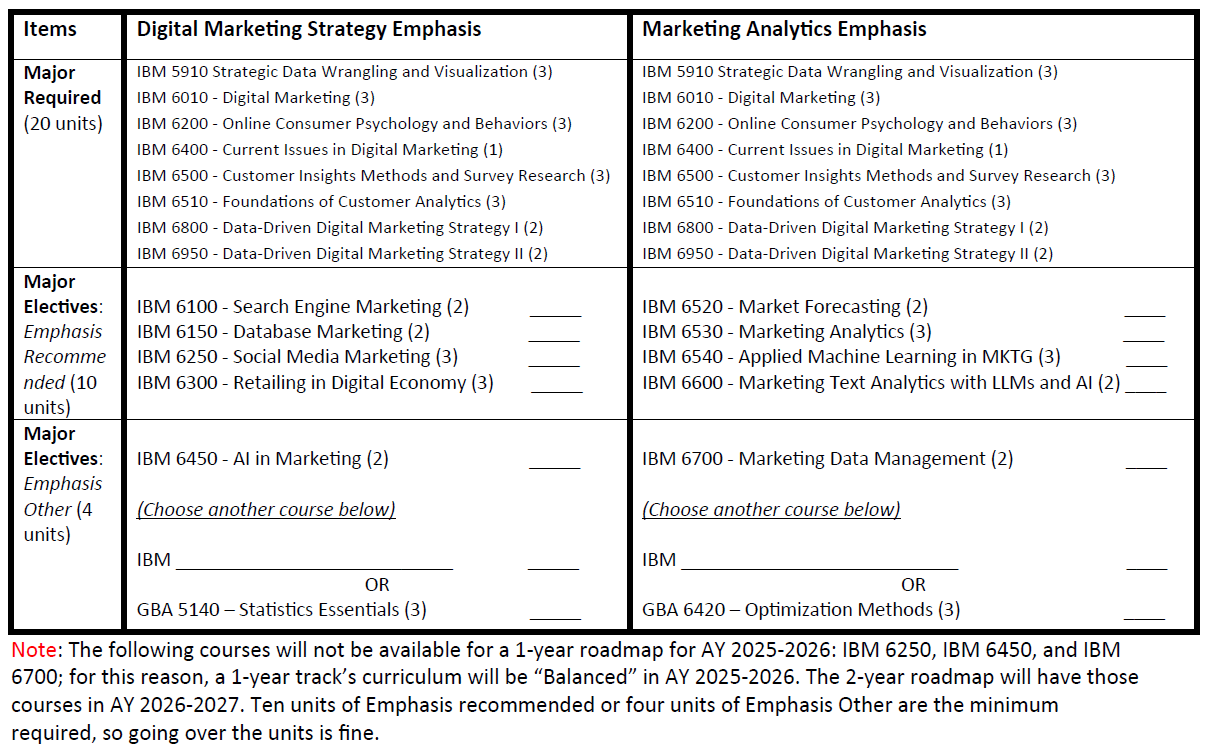
For the Curriculum Overview, you may visit the official web page for the curriculum, but the implication is that there are basically three curriculum options for you. Select the one that would be best match for your aspired career path. In Step 4, you will be provided with the factors to consider when choosing degree emphasis.
Three Curriculum (Degree Emphasis) Options
Digital Marketing Strategy (DMS) Emphasis
- This emphasis is best suited for students who want to have a career in Content & Creative Roles, such as Content Writer/SEO Writer and Social Media Manager.
- For Major Electives: Emphasis Recommended, choose all 10 units under DMS Emphasis: IBM 6100, IBM 6150, IBM 6250, and IBM 6300
- For Major Electives: Emphasis Other, choose IBM 6450 and one more course from any other graduate-level IBM-prefix courses or GBA 5140.
Marketing Analytics (MA) Emphasis
- This emphasis is best suited for students who want to have a career in Marketing Data Specialist Roles such as Marketing Data Scientist, Marketing Engineer, and Marketing Data Analyst.
- For Major Electives: Emphasis Recommended, choose all 10 units under MA Emphasis: IBM 6520, IBM 6530, IBM 6540, and IBM 6600
- For Major Electives: Emphasis Other, choose IBM 6700 and one more course from any other graduate-level IBM-prefix courses or GBA 6520.
Balanced/Customized
This track is best suited for students who want to have a career in various Technical & Performance Roles such as SEO Specialist, PPC Specialist, Email Marketing Specialist, Marketing data analyst, except for Marketing Data Scientist or Marketing Engineer, for which MA Emphasis will be a better fit.
If you want to be well-rounded so that you can be prepared for various digital marketing roles across content, performance, and analytics, balanced option will be ideal.
This option allows you to choose courses from both emphases to tailor to your career needs and your current set of skills and knowledge. For example, if you have been working as a social media coordinator for an organization and want to keep pursuing your career on Content and Creative Roles, you should have pretty good working knowledge about social media platforms and strategy. In that case, there is no reason to take IBM 6250 (Social Media Marketing); instead, you can take any other remaining electives (from MA Emphasis) to expand your skills and knowledge.
7 Step 3: Know Curriculum Completion Roadmap Options
Each course is offered only once per year in a designated term due to prerequisites and scheduling constraints.
Therefore, you must plan your course sequence carefully to ensure you can complete all required courses within your desired timeframe (1-year, 1.5-year, or 2-year).
As a rule of thumb, all students following the 2-year or the 1.5-year completion roadmap should take at least six credits in fall, spring, and summer semesters except for their final summer semester, in which, you will take remaining units.
Taking summer off is not recommended for the first summer semester even though all first summer courses are electives, because of multiple reasons:
It will be harder for you to catch up with the course sequence if you take summer off in the first summer semester, because you will have to take more units in the following fall and spring semesters, which can be overwhelming.
You will miss out on the opportunity to take electives in the first summer semester. Those courses help you explore different areas of digital marketing and build your skills and knowledge you need for the MSDM Capstone Project that will start in your second fall semester.
- This has implications especially for spring admitted students, because they will have only one semester’s of study before the capstone project starts their Capstone Project in their first fall semester.
Taking summer off in the first summer semester can also delay your graduation and career plans, as you will have to wait until the next summer semester to take remaining courses. In the second summer, you will want to have lighter workload to focus on your capstone project and job search, so it is better to take some courses in the first summer semester.
Finally, some electives on the roadmap to be offered in the fall or spring may not be available due to scheduling or enrollment constraints, so it is better to take some electives in the first summer semester to ensure you can complete your degree on time.
7.1 Fall-Admitted Students
Students admitted in the fall semester can choose between a 1-year or 2-year completion roadmap.
Students who want to complete the program in 2 years should take about six units in each fall, spring, and summer semester for the first two years, and then take remaining units in the final summer semester.
Students who want to complete the program in 1 year should take about 12 units in each fall and spring semester, and then take remaining units in the final summer semester.
The curriculum completion roadmap worksheets for fall-admitted students are available below.
7.1.1 Fall 2027 Cohort
Curriculum completion roadmap worksheet for students admitted in the fall 2027 semester
Two worksheet options (2-year and 1-year tracks) are included in the file.
Note: Since the file is for all the students, you are not given edit access. Do not try to edit it; instead download the file first and then modify it. If you have trouble accessing the files, please contact Dr. Jung.
7.1.2 Fall 2026 Cohort
Curriculum completion roadmap worksheet for students admitted in the fall 2026 semester
Two worksheet options (2-year and 1-year tracks) are included in the file.
Note: Accessing requires Cal Poly Poomona login. If you have trouble accessing the files, please contact Dr. Jung.
7.1.3 Fall 2025 Cohort
Curriculum completion roadmap worksheet for students admitted in the fall 2025 semester
Two worksheet options (2-year and 1-year tracks) are included in the file.
Note: Accessing requires Cal Poly Poomona login. If you have trouble accessing the files, please contact Dr. Jung.
7.2 Spring-Admitted Students
1.5-year vs. 2.5-year Roadmap. Students admitted in the Spring semester are advised to take a 1.5-year completion roadmap or 2.5-year roadmap, as it supports your learning journey the best. The 2-year completion roadmap will be available as an exception.
The main reason for the recommendation is that the 1.5-year completion roadmap allows you to catch up with fall-admitted students in learning journey fastest.
That is, we offer IBM 5910 (Strategic Data Wrangling and Visualization) to teach you R Programming comprehensively and systematically and basic statistics, which will benefit the rest of analytics courses. Unless you are already familiar with the topic, it is the best to catch up fast. Taking it in your last semester doesn’t support your learning journey well.
Another course, IBM 6010 (Digital Marketing Strategy) surveys all aspects of digital marketing, serving you as an introduction to digital marketing. The course is more qualitative. It is better to take this earliest, but not taking it early would not impede you in your learning journey.
For these reasons, it is best to take all four required courses in the first fall semester. Those two courses support your Culminating Experience Project (CEP) that starts in the first fall semester and ends in the second summer term. Taking the required courses after the CEP will beat the purpose of CEP.
Students who want to complete the program in 1.5 years should take about six units in each spring, summer, and fall semester just like 2 year-completion roadmap for fall admits, but they should take four required courses (IBM 6200, IBM 6500, IBM 5910 and IBM 6010) in their first fall semester.
They graduate in the summer of their second year just like 2-year completion roadmap students who were admitted in the fall.
This means that they will participate in the commencement ceremony in the spring semester of their second year, which is the same time as 2-year completion roadmap students who were admitted in the fall.
2.5-year Roadmap. Students who cannot take all four required courses in the first fall semester due to workload issues should take 2.5-year Roadmap.Likewise, students who have not taken a math and statistics in their undergraduate programs are highly recommended to follow 2.5-year Roadmap.
Students admitted in the Spring semester may take a 2.5-year completion roadmap if they have a special reason, such as working full-time while in the program or having family responsibilities, coupled with concern about their performance in IBM 6510 (Foundations of Customer Analytics), which is a second course in statistics that assumes that you know basic statistical concepts (e.g., descriptive statistics, hypothesis testing, etc.), which is taught in an undergraduate introductory statistics course. Such prerequisite materials are covered in IBM 5910 (Strategic Data Wrangling and Visualization) that is offered in the fall semester.
Under 2.5-year roadmap, students can take about four units in the first spring (IBM 6100 and IBM 6150), take summer off, and then basically follow two-year roadmap from the first fall semester by taking about six units evenly throughout the rest of the journey with the exception of the second spring when there will be less than six units available for them.
2-year Roadmap. Students may be allowed to complete the program in 2 years in which case they should take about six units in each spring, summer, and fall semester evenly throughout the two years with the exception of the first fall semester.
In the first fall, they still need to take one more required course (IBM 5910) with a total of three required courses (IBM 6200, IBM 6500, and IBM 5910). IBM 6010 may be taken in the second fall semester.
Because they will finish the program in the second fall semester and the university holds only one commencement ceremony per year in the spring semester, they will have to wait until the next spring semester to participate in the commencement ceremony.
Students in this roadmap will complete MSDM CEP by their second summer and take the two remaining courses in the summer.
Students starting in Spring are advised to follow 1.5 year-completion roadmap (graduating after second summer semester) or 2.5-year-completion roadmap. The 2-year-completion roadmap is offered only as an exception.
The main difference between the 1.5-year and 2-year roadmaps is when the required courses should be taken.
1.5-year Completion Roadmap Students
IBM 6500 (first fall semester)
IBM 6200 (first fall semester)
IBM 5910 (first fall semester)
IBM 6010 (first fall semester)
2-year Completion Roadmap Students
IBM 6500 (first fall semester)
IBM 6200 (first fall semester)
IBM 5910 (first fall semester)
IBM 6010 (second fall semester)
The 2.5-year completion roadmap is intended to give students more time to prepare for IBM 6510 (Foundations of Customer Analytics) by allowing them to go slowly in the first two semesters (spring and summer) and join fall admits on their roadmap in taking IBM 5910 (Strategic Data Wrangling and Visualization). Students who are concerned about their performance in IBM 6510 should take a 2.5-year completion roadmap.
The curriculum completion roadmap worksheets for spring-admitted students are available below.
7.2.1 Spring 2027 Cohort
Curriculum completion roadmap worksheet for students admitted in the spring semester
Three worksheet options (1.5-year, 2.5-year, and 2-year tracks) are included in the file.
Note: Since the file is for all the students, you are not given edit access. Do not try to edit it; instead download the file first and then modify it. If you have trouble accessing the files, please contact Dr. Jung.
7.2.2 Spring 2026 Cohort
Curriculum completion roadmap worksheet for students admitted in the spring semester
Three worksheet options (1.5-year, 2.5-year, and 2-year tracks) are included in the file.
Note: Accessing requires Cal Poly Poomona login. Since the file is for all the students, you are not given edit access. Do not try to edit it; instead download the file first and then modify it. If you have trouble accessing the files, please contact Dr. Jung.
8 Step 4: Which Curriculum Option to Choose?
Choosing between Digital Marketing Strategy, Marketing Analytics, and Balanced/Customized Option requires careful thought. Below are key factors to guide your decision.
8.1 VISA Status (Domestic vs. International Students)
8.1.1 Domestic Students
Domestic students typically face fewer constraints in hiring. Job outcomes depend mainly on experience, skill fit, and flexibility on role, location, and compensation.
8.1.2 International Students
International students often face different hiring realities:
A. OPT/STEM OPT is usually “easier” for employers than H-1B
During OPT/STEM OPT, you already have work authorization, so many employers can hire you with relatively low legal burden.
For STEM OPT, employers must be in E-Verify and support the student’s Form I-983 training plan requirements.
B. H-1B is employer-sponsored and more demanding
H-1B requires the employer to file an H-1B petition for a “specialty occupation” role (typically one that requires a bachelor’s degree or higher in a specific specialty).
Employers must also file a Labor Condition Application (LCA) and attest to wage and working condition requirements.
C. Hiring on OPT and sponsoring H-1B are often different decisions
- An employer may be willing to hire for OPT/STEM OPT but not sponsor H-1B because H-1B involves legal filings, fees, compliance obligations, and (for many employers) timing uncertainty.
If your priority is maximizing long-term U.S. work options, you are often better positioned in roles that clearly align with specialized, degree-linked skills—especially analytics and more technical performance/MarTech roles.
Marketing Analytics emphasis: generally strongest alignment with “specialty occupation” patterns (measurement, experimentation, modeling, data work).
Balanced/Mixed option: a strong second choice if you intentionally build technical/analytics depth (e.g., SQL, analytics implementation, experimentation, BI).
Digital Marketing Strategy emphasis: can still lead to great careers, but sponsorship can be less common in roles that are primarily creative, coordination, or generalist execution—because degree specificity may be harder to document.
Note: This is general information, not legal advice. Sponsorship depends on the employer, the exact job description, and current rules.
8.2 Your Passion
Entry to mid-level career jobs in Digital Marketing can be grouped under three big categories before they move into leadership roles. For details about the taxonomy, refer to Typical Job Roles in Digital Marketing.
Content & Creative Roles
Techncial & Performance Roles
Analytics (Marketing Data Specialist) Roles
Based on the immediate career goal right after graduation, my recommendation for Degree Emphasis would be different as follows:
If you prefer to take Content & Creative Roles, such as content writer/SEO writer, copy writer, social media manager, and graphics/visual designer –> choose Digital Marketing Strategy Emphasis.
If you prefer to take Technical & Performance Roles, such as SEO Specialist, PPC Specialist, and Email Marketing Specialist –> choose Balanced/Mixed Option.
If you prefer to take Analytics (Marketing Data Specialist) Roles, such as Marketing Data Analytist, Marketing Data Scientist, and Marketing Data Engineer –> choose Marketing Analytics Emphasis.
8.3 Pay (ROI) Considerations
For the early career stage of jobs you will be seeking right after graduation, we will focus on the three roles below, leaving out the strategy/leadership roles, which are the latter stage of your career.
Content & Creative Roles
- Content Marketer/Copywriter: $61,000 – $73,660
- Social Media Manager: $64,000 – $74,536
Technical & Performance Roles
- SEO Specialist / Analyst: $66,000 – $81,407
- PPC / Paid Media Specialist: $70,000 - $81,000
- Email / CRM Specialist: $79,911 – $95,000
Analytics Roles
- Marketing Data Analyst: $82,000 – $93,336
- Marketing Data Scientist: $118,000 – $165,018
- Marketing Data Engineer: $134,000 – $195,000
For details, go to the Job Outlook and Salary section.
In general, Return On Investment is in this order: Analytics Roles > Technical & Performance Roles > Content & Creative Roles.
If you’re aiming for the highest ROI (typically, higher pay), analytics roles are often the best path. In that case, consider choosing the Marketing Analytics Emphasis.
8.4 Upward mobility
Many students pursue a master’s degree to advance their careers.
Note on career stage: Strategy and leadership roles are often mid-career+. Many MSDM graduates start in specialist roles (content, performance, or analytics) and move into strategy/leadership after building execution + measurement + cross-functional experience. The pathway for the students would be like this:
Entry-level: Coordinator, Specialist, Analyst (Jr.)
Mid-level: Manager, Strategist, Senior Specialist/Analyst
Senior: Lead, Director, Head of Growth/Marketing
A common pattern is:
Students with digital marketing work experience often reach a ceiling due to limited analytics skills.
Higher-level roles (e.g., Director, VP of Digital Marketing) generally require balanced knowledge of strategy and analytics.
If you already have several years of digital marketing experience → Consider Marketing Analytics courses.
If you handle data but lack confidence in statistics or machine learning → Strengthen your Marketing Analytics foundation.
8.5 Strategic Consideration
You are not required to follow the recommended elective lists exactly. Choose the courses that best strengthen your skills and make you a well-rounded professional. We support a customized curriculum within the allowed electives. This makes the Balanced/Mixed Option attractive.
9 Step 5: Which Completion Roadmap to Choose?
As you prepare for your curriculum contract and make an appointment to meet with me, I want to provide you with some information to consider in your decision to choose a 1-year vs. a 2-year completion roadmap.
Recommended if any of the following are true
You are working while in the program.
You have limited preparation in math, statistics, or programming.
You want more time to strengthen English skills.
You are an international student who needs time to acclimate.
You want to participate fully in extracurricular activities (club, competitions, workshops, symposiums).
Doable if most of the following apply
You do not have a job or family responsibilities.
You have taken college algebra, calculus, and at least one statistics course.
You earned a BS in Business Administration from an AACSB-accredited university.
You are an international student planning to return home immediately after graduation and want to minimize cost.
Financial Impact: 1-Year vs. 2-Year Roadmap
Tuition is the same overall, but auxiliary fees differ:
Auxiliary fees: ~$850/semester, ~$400/summer
Two-year students pay more total auxiliary fees
One-year students save approximately $2,100
10 Step 6: Complete Your Roadmap Worksheet
Use one of the worksheets below to plan your curriculum completion roadmap for the duration of your study.
- For information about the curriculum completion roadmap, see the Section 7.
Since all the worksheet files (.xlsx) are for all the students, you are not given edit access. Do not try to edit the file on the web; instead download the file first and then modify it.
- Save it with your first name_last name in front of the file name, choose the correct worksheet for your roadmap, fill out the worksheet, and email the completed worksheet to the academic advisor.
Failure to submit the (1) curriculum contract and (2) roadmap worksheet will result in an advising hold, which will prevent you from registering for future courses.
10.1 Fall-Admitted Students
10.1.1 Fall 2026 Cohort
Curriculum completion roadmap worksheet for students admitted in the fall 2026 semester
- Two worksheet options (2-year and 1-year tracks) are included in the file.
10.1.2 Fall 2025 Cohort
Curriculum completion roadmap worksheet for students admitted in the fall 2025 semester
- Two worksheet options (2-year and 1-year tracks) are included in the file.
10.2 Spring-Admitted Students
10.2.1 Spring 2027 Cohort
Curriculum completion roadmap worksheet for students admitted in the spring semester
- Two worksheet options (2-year and 1.5-year tracks) are included in the file.
10.2.2 Spring 2026 Cohort
Curriculum completion roadmap worksheet for students admitted in the spring semester
- Two worksheet options (2-year and 1.5-year tracks) are included in the file.
- If you are following a two-year completion roadmap, please note that course sequencing has changed for the first fall and second fall semester. Please take IBM 5910 (Strategic Data Wrangling and Visualization) in your first fall semester to support IBM 6500 and the Capstone Project.
11 Step 7: Submit the (1) Curriculum Contract Form and (2) Curriculum Completion Roadmap Worksheet to Your Advisor
If you have not done already in Step 1, fill out the Curriculum Contract form introduced in Section 5). When you click the submit button on the Google form, your advisor will receive the form. At the same time, you will receive a copy for your reference.
In the form, you will be asked to fill out a Curriculum Completion Roadmap Worksheet (Excel spreadsheet) and email it as an attachment to the academic advisor (Dr. Jae Jung).
Once I receive an email with your Curriculum Roadmap Worksheet, I will review it and give you feedback.
Your Curriculum Worksheet will be placed under your folder. If you ever needs to change curriculum later, contact me. I will be happy to discuss with you and assisting you in finding best courses for your career path.
WarningNoteFailure to submit the (1) curriculum contract and (2) roadmap worksheet will result in an advising hold, which will prevent you from registering for future courses.
12 Step 8: Register for Courses
Before registering each semester, review your Curriculum Completion Roadmap Worksheet that you completed in Step 6. It helps you plan course sequencing and stay on track for graduation.
For the courses available for a specific semester, go to the Course Registration tab in the menu, where you will also be guided on how to register.
After you register for your first semester, consider taking Boot Camp short courses if you’d like to strengthen your skills in Excel or R (including Statistics).
You can also review Course-Skill-Tools alignment table to better understand what each course emphasizes and what to expect.
Footnotes
This step can be skipped if you do not have any questions on the curriculum options and curriculum completion roadmap, which is explained in Step 1 through Step 7 on this page.
↩︎For any questions about the curriculum, course registration, or any other program-related questions, please feel free to reach out to me via email or schedule an appointment. I am here to support you throughout your academic journey and help you make informed decisions about your curriculum and career path. For contact information, please refer to the Contact Information section on the Resources page.
Program director (Dr. Jung) is your academic advisor.↩︎